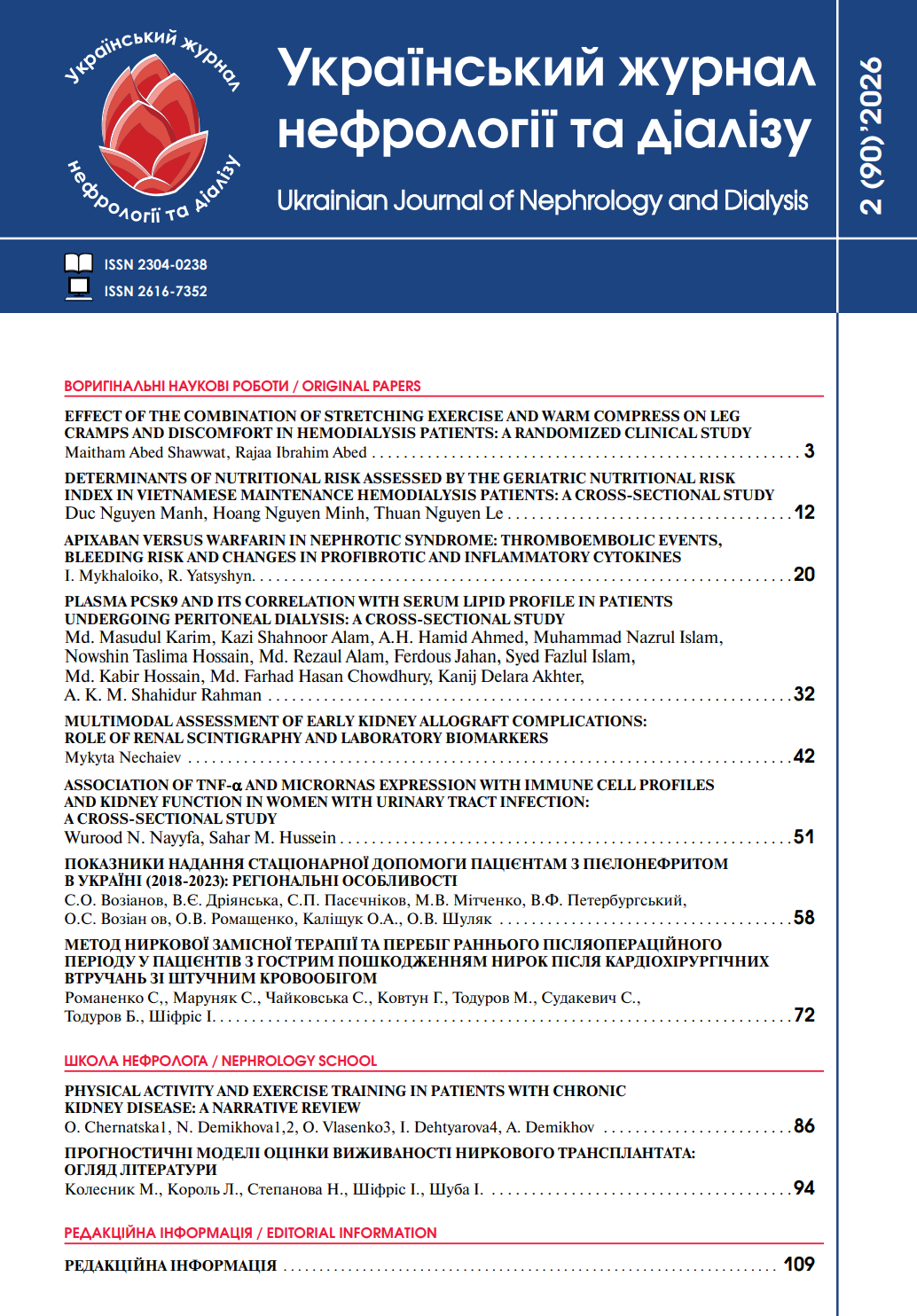
Effect of the combination of stretching exercise and warm compress on leg cramps and discomfort in hemodialysis patients: A randomized clinical study
Abstract
Patients undergoing hemodialysis have a variety of negative effects on their quality of life, health, and comfort, including physical dysfunction, alterations to their diet, and limits on fluid intake. This study aimed to determine the effects of intradialytic exercise and heat compression on alleviating discomfort and leg cramps in individuals receiving hemodialysis.
Methods. A multicenter randomized clinical study was conducted in Iraqi hemodialysis facilities. A total of 205 patients receiving hemodialysis were randomized into four groups: warm compress group (n = 53), stretching exercise group (n = 43), combined warm compress and exercise group (n = 57), and control group (n = 52). The intervention was applied during hemodialysis sessions over four weeks. Comfort was assessed using the Hemodialysis Comfort Scale, while leg cramps were evaluated using the Cramp Questionnaire Chart. Pre- and post-intervention scores were compared using paired-sample t-tests and repeated-measures ANOVA.
Results. The combined intervention group demonstrated the greatest improvement in comfort scores, increasing from 61.74 ± 20.24 before the intervention to 100.99 ± 7.21 after the intervention (p < 0.001). The exercise group also showed a significant increase in comfort scores, from 62.30 ± 25.17 to 85.19 ± 3.92 (p < 0.001), whereas no significant change was observed in the warm compress group (66.43 ± 21.20 to 67.38 ± 18.26; p = 0.816) or the control group (61.15 ± 21.88 to 60.62 ± 18.39; p = 0.902). Repeated-measures ANOVA showed significant effects of time, group, and time × group interaction on comfort scores (F = 148.62, 96.13, and 192.39, respectively; p = 0.001; partial η² = 0.64). Cramp scores decreased significantly in the warm compress group (9.23 ± 2.76 to 3.66 ± 4.98; t = 7.567; p < 0.001), exercise group (8.35 ± 3.61 to 5.44 ± 2.67; t = 5.839; p < 0.001), and combined intervention group (9.37 ± 2.46 to 3.68 ± 0.73; t = 17.544; p < 0.001), while no significant improvement was observed in the control group (8.13 ± 2.44 to 8.81 ± 2.42; p = 0.171). Repeated-measures ANOVA confirmed significant time, group, and time × group effects for cramp scores (F = 112.47, 28.90, and 134.21, respectively; p = 0.001; partial η² = 0.57).
Conclusions. The combination of warm compresses and stretching exercise was the most effective non-pharmacological nursing intervention for reducing leg cramps and improving comfort among hemodialysis patients. These procedures are safe, non-invasive, cost-effective, and may be incorporated into routine nursing care during hemodialysis.
Trial registration: WHO International Clinical Trials Registry Platform / TrialSearch, Main ID: IRCT20240828062892N1.
Downloads
References
Copyright (c) 2026 Ukrainian Journal of Nephrology and Dialysis

This work is licensed under a Creative Commons Attribution-ShareAlike 4.0 International License.


