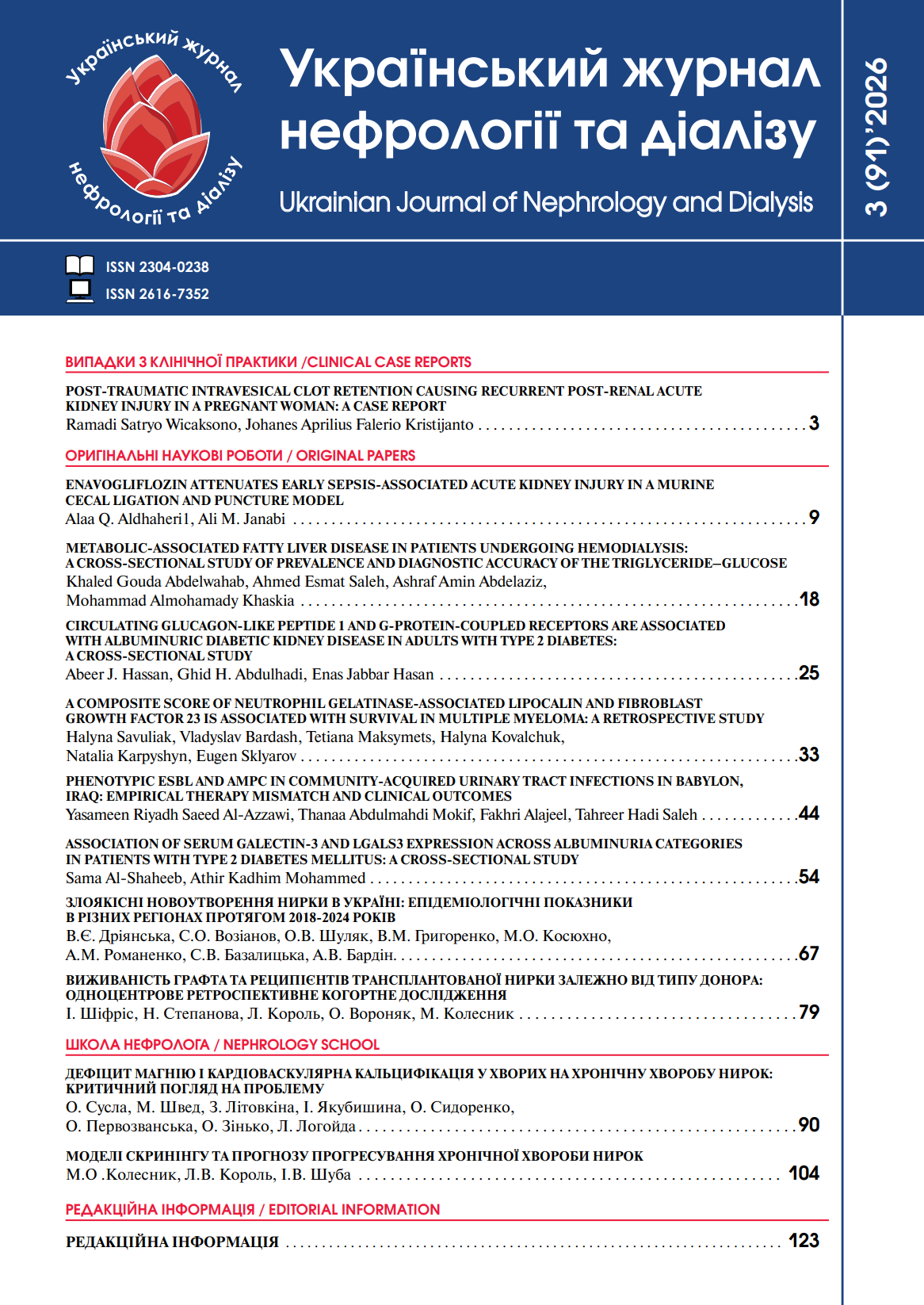
Metabolic-associated fatty liver disease in patients undergoing hemodialysis: A cross-sectional study of prevalence and diagnostic accuracy of the triglyceride–glucose index

Keywords: fatty liver, triglyceride-glucose index, insulin resistance, end-stage kidney disease, hemodialysis, liver fibrosis

Abstract

Metabolic dysfunction-associated fatty liver disease (MAFLD) is increasingly recognized in patients with metabolic and renal disorders; however, data in hemodialysis populations remain limited. This study assessed the prevalence of MAFLD in patients receiving maintenance HD and identified factors associated with its presence.

Methods. A total of 95 patients with end-stage kidney disease (ESKD) receiving maintenance HD were included in this cross-sectional study conducted at Ain Shams University Hospital from January to September 2024. Clinical assessment, abdominal ultrasonography, and laboratory investigations were performed. The triglyceride-glucose (TyG) index, non-alcoholic fatty liver disease (NAFLD) fibrosis score, and fibrosis-4 (FIB-4) score were calculated.

Results. MAFLD was identified in 21 of 95 patients (22.1%). Compared with patients without MAFLD, those with MAFLD had significantly higher body mass index (35.14 ± 3.09 vs. 25.51 ± 4.74 kg/m²), WC (116.95 ± 6.74 vs. 100.24 ± 9.56 cm), CRP (20.38 ± 5.24 vs. 4.59 ± 2.49 mg/L), ALT, AST, TC, LDL-C, triglycerides, TyG index (9.20 ± 0.34 vs. 8.63 ± 0.27), NAFLD fibrosis score, and FIB-4 score (all P < 0.05). Hemoglobin and albumin were substantially lower in the MAFLD group. The TyG index showed high discrimination for MAFLD, with an AUC of 0.906 (95% CI, 0.815–0.998); at a cutoff >8.88, sensitivity was 95.2% and specificity was 82.4%.

Conclusions. MAFLD is common among patients receiving hemodialysis and is associated with metabolic and inflammatory disturbances. The TyG index showed promising discriminative performance for identifying MAFLD in this population. However, the findings are exploratory and require validation in larger, multicenter studies.

Downloads

Download data is not yet available.

References

Miller DM, McCauley KF, Dunham-Snary KJ. Metabolic Dysfunction-Associated Steatotic Liver Disease (MASLD): Mechanisms, Clinical Implications and Therapeutic Advances. Endocrinol Diabetes Metab. 2025;8(6):e70132. doi: 10.1002/edm2.70132.

Souto Maior M, Ribeiro NLI, Silva HVV, Lopes EP, Costa EC. Metabolic Dysfunction-Associated Steatotic Liver Disease as a Risk Factor for Chronic Kidney Disease: A Narrative Review. Biomedicines. 2025;13(9):2162. doi: 10.3390/biomedicines13092162.

Cao X, Wang N, Yang M, Zhang C. Lipid Accumulation and Insulin Resistance: Bridging Metabolic Dysfunction-Associated Fatty Liver Disease and Chronic Kidney Disease. Int J Mol Sci. 2025;26(14):6962. doi: 10.3390/ijms26146962.

Fei DL, Liu Y, Liu J, Yu Z, Dong JL. Gut microbiota and the "gut-liver-kidney axis" theory: from mechanisms to therapeutics. Front Microbiol. 2025;16:1554458. doi: 10.3389/fmicb.2025.1554458.

Swift O, Sharma S, Ramanarayanan S, Umar H, Laws KR, Vilar E, et al. Prevalence and outcomes of chronic liver disease in patients receiving dialysis: systematic review and meta-analysis. Clin Kidney J. 2022;15(4):747-57. doi: 10.1093/ckj/sfab230.

Fouad Y, Alboraie M, Shiha G. Epidemiology and diagnosis of metabolic dysfunction-associated fatty liver disease. Hepatol Int. 2024;18(Suppl 2):827-33. doi: 10.1007/s12072-024-10704-3.

Wong WK, Chan WK, Ganapathy SS, Lim SK. Metabolic dysfunction-associated fatty liver disease (MAFLD) and advanced liver fibrosis among hemodialysis patients in a multiethnic urban population in Malaysia. Semin Dial. 2023;36(2):107-16. doi: 10.1111/sdi.13117.

Deng Y, Zhao Q, Gong R. Association Between Metabolic Associated Fatty Liver Disease and Chronic Kidney Disease: A Cross-Sectional Study from NHANES 2017-2018. Diabetes Metab Syndr Obes. 2021;14:1751-61. doi: 10.2147/DMSO.S292926.

Tanaka M, Mori K, Takahashi S, Higashiura Y, Ohnishi H, Hanawa N, et al. Metabolic dysfunction-associated fatty liver disease predicts new onset of chronic kidney disease better than fatty liver or nonalcoholic fatty liver disease. Nephrol Dial Transplant. 2023;38(3):700-11. doi: 10.1093/ndt/gfac188.

Zou Y, Zhao L, Zhang J, Wang Y, Wu Y, Ren H, et al. Metabolic-associated fatty liver disease increases the risk of end-stage renal disease in patients with biopsy-confirmed diabetic nephropathy: a propensity-matched cohort study. Acta Diabetol. 2023;60(2):225-33. doi: 10.1007/s00592-022-01978-w.

Xue Y, Xu J, Li M, Gao Y. Potential screening indicators for early diagnosis of NAFLD/MAFLD and liver fibrosis: Triglyceride glucose index–related parameters. Front Endocrinol (Lausanne). 2022;13:951689. doi: 10.3389/fendo.2022.951689.

Liu H, Chen J, Qin Q, Yan S, Wang Y, Li J, et al. Association between TyG index trajectory and new-onset lean NAFLD: a longitudinal study. Front Endocrinol (Lausanne). 2024;15:1321922. doi: 10.3389/fendo.2024.1321922.

Zhang HJ, Wang YY, Chen C, Lu YL, Wang NJ. Cardiovascular and renal burdens of metabolic associated fatty liver disease from serial US national surveys, 1999-2016. Chin Med J (Engl). 2021;134(13):1593-601. doi: 10.1097/CM9.0000000000001513.

Sun DQ, Jin Y, Wang TY, Zheng KI, Rios RS, Zhang HY, et al. MAFLD and risk of CKD. Metabolism. 2021;115:154433. doi: 10.1016/j.metabol.2020.154433.


Abstract views: 1
PDF Downloads: 0
Published
2026-08-25
How to Cite
Abdelwahab, K. G., Saleh, A. E., Abdelaziz, A. A., & Khaskia, M. A. (2026). Metabolic-associated fatty liver disease in patients undergoing hemodialysis: A cross-sectional study of prevalence and diagnostic accuracy of the triglyceride–glucose index. Ukrainian Journal of Nephrology and Dialysis, (3(91), 18-24. https://doi.org/10.31450/ukrjnd.3(91).2026.03