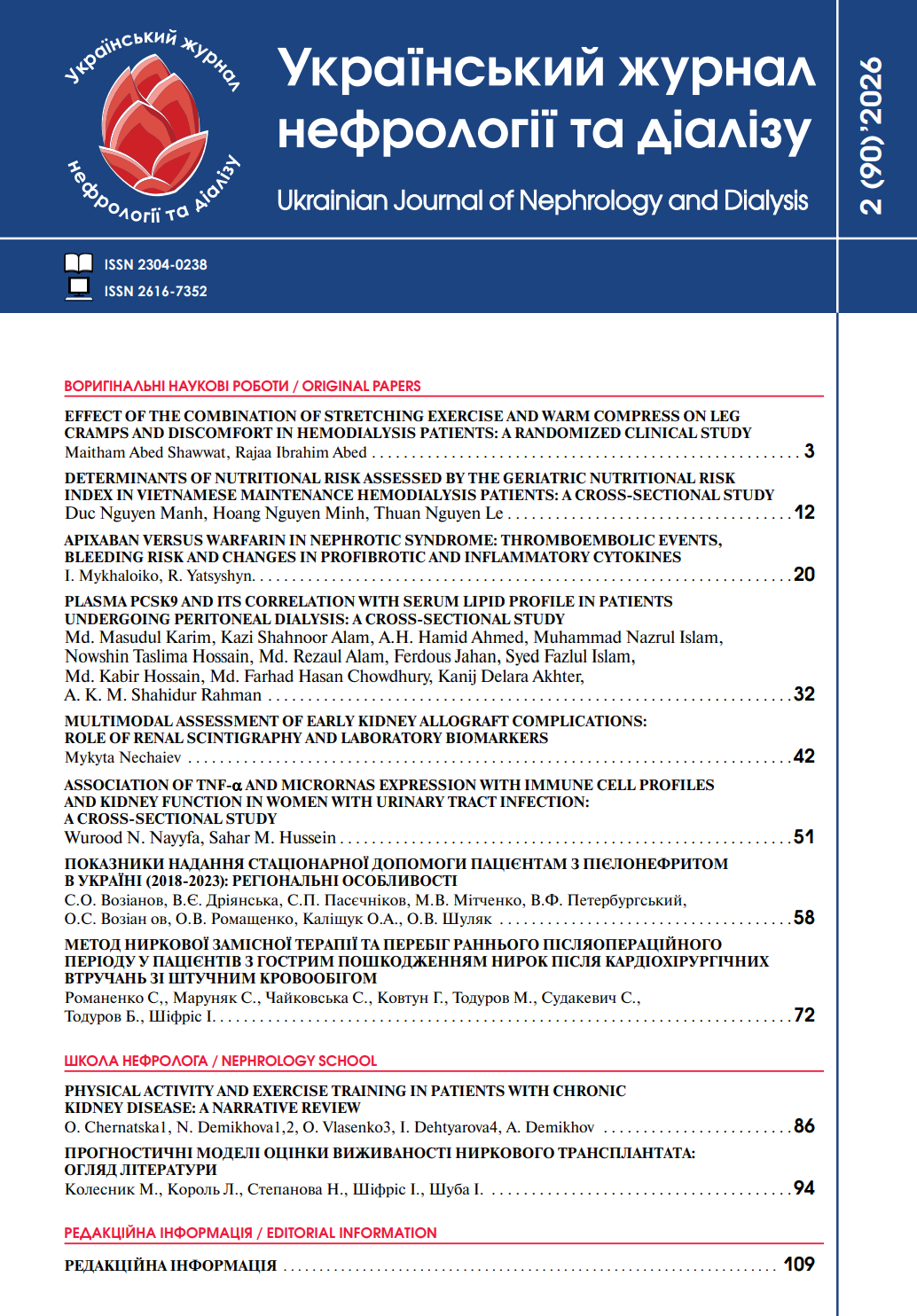
Hospital care indicators for patients with pyelonephritis in Ukraine (2018–2023): Regional characteristics
Abstract
The public health monitoring system is an important component for resource planning, with a particular focus on analyzing inpatient care indicators in the country and regions, especially during periods of emergencies in society (epidemics, military actions, etc.).
The aim of the study is to analyze indicators of hospital morbidity among the adult and pediatric populations, as well as regional and provincial characteristics of dynamics in patients with acute (AP) and chronic (CP) pyelonephritis over the last 6 years (2018-2023).
Materials and methods. The source of data was statistical compilations for the analysis of epidemiological indicators of inpatient medical care for patients with AP and CP. The data obtained were considered both for Ukraine as a whole with regions, and for each of the 5 regions – Western, Central, North-Eastern, South-Eastern, Southern – and for the regions that comprise them, as well as for the city of Kyiv. For statistical processing using the software packages “SPSS for Windows, Version 11” and “MedStat,” the chi-square criterion was used, comparing the proportions for two groups using Fisher's angular transformation (with Yates' correction); a difference of p<0.05 was considered significant.
Results. It has been shown that the number of adults and children per 100,000 population treated in hospitals for AP and CP has been declining since 2018, reaching a minimum in 2020-2021, and then slowly increasing; the same, but reverse dynamics of adult mortality (p=0.008), which in these two years increases by 84% in patients with AP and by 100% in patients with CP, and both indicators do not reach the initial observation levels in 2022-2023. A direct link between this and the peak of the COVID-19 epidemic and subsequent military actions cannot be ruled out.
Regional differences in the number of patients treated (per 100,000) were identified, with the highest numbers in the Central region and the lowest in the Southern region and the Donetsk and Luhansk oblasts, as well as in the Kharkiv oblast for adults and the Zakarpattia and Chernihiv oblasts for children. The levels of hospital treatment for AP and CP in adults and children have been steadily increasing since 2022 in the Central and Western regions due to a decrease in the South-East and South, which correlates with the start of hostilities in Ukraine, as well as lower rates of treated patients and higher mortality rates in 2022-2023 compared to 2018-2019.
The duration of inpatient treatment for adults and children with AP and CP will decrease by an average of 20% between 2018 and 2023, and by 30% for children with CP. In adults and children, the longest average duration of inpatient treatment (respectively, >10 and >12) is in the South-East region, with a notable spike in Kyiv in 2020 (and in children in 2021) during the coronavirus epidemic.
Conclusions. The identified dynamics of inpatient care indicators for adults and children with AP and CP, which correlate with the peculiarities of emergencies in the country (COVID-19 epidemic, military actions), allow for the timely adoption of appropriate administrative decisions to maintain the current level of effective in patient medical care for urological and nephrological patients.
Downloads
References
Saidakova NO, Startseva LM, Kononova GE, Kravchuk NG. The main indicators of urological care in Ukraine for 2018-2019 years: departmental publication; Ministry of Health of Ukraine; State University "Institute of Urology of the National Academy of Sciences of Ukraine"; DZ Center of Medical Statistics of the Ministry of Health of Ukraine. Kyiv: Polium; 2019. 121 p. [In Ukrainian].
Saidakova NO, Startseva LM, Kononova GE, Kravchuk NG. The main indicators of urological care in Ukraine for 2020-2021 years: departmental publication; Ministry of Health of Ukraine; State University "Institute of Urology of the National Academy of Sciences of Ukraine"; DZ Center of Medical Statistics of the Ministry of Health of Ukraine. Kyiv: Polium; 2022. 121 p. [In Ukrainian].
Lekhan VM, Shherbinina MB, Volchek VV. Reserves for improving efficiency in the stationary health sector. Medychni perspektyvy. 2006;3:73-81.
Pariy VD, Hryshchuk SM, Borys VM. The main approaches to the definition of a hospital intensive care when creating Hospital districts. Scientific J. 2015;10/3:97-100.
Bugro VI. Study of validity of hospitalization and bed capacity use of specialized Hospital health institutions of secondary medical care. Visnyk naukovyh doslidzhen. 2016;1:6-9.
European health for all database (HFA-DB). Available: https:// gateway.euro.who.int/en/datasets/european-health-for-all-database [Accessed 15 Jun 2018].
Copyright (c) 2026 Ukrainian Journal of Nephrology and Dialysis

This work is licensed under a Creative Commons Attribution-ShareAlike 4.0 International License.


