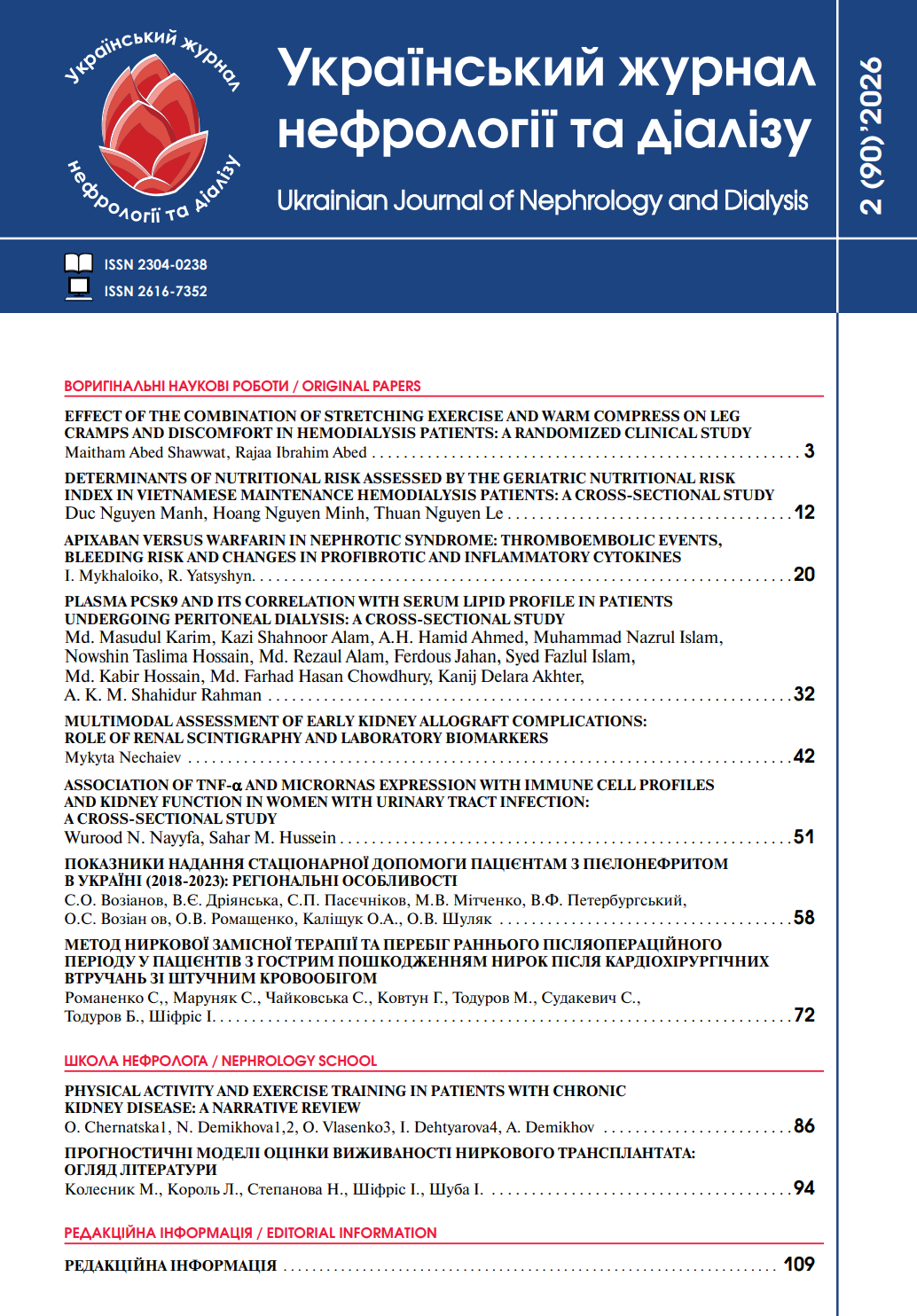
Physical activity and exercise training in patients with chronic kidney Disease: A narrative review

Keywords: renal insufficiency, chronic; exercise therapy; exercise, aerobic; resistance training; ubiquitination; cardiorespiratory fitness.

Abstract

Physical activity (PA) is a non-pharmacological intervention that may improve cardiovascular risk, functional capacity, muscle strength, inflammation, and quality of life in patients with chronic kidney disease (CKD). However, practical use of PA remains limited because exercise prescription should differ according to CKD stage, dialysis status, comorbidity burden, and baseline physical capacity.

The aim of this narrative review was to summarize mechanisms linking PA and CKD, evaluate clinical evidence for aerobic, resistance, balance, and low-intensity exercise, and formulate practical recommendations for non-dialysis and dialysis patients.

The reviewed evidence supports regular aerobic activity, resistance and balance training, and reduction of sedentary time in clinically stable non-dialysis CKD. Expected benefits include better cardiorespiratory fitness, muscle performance, endothelial function, inflammatory profile, and physical functioning.

For dialysis patients and patients with advanced CKD, individualized low-intensity activity, especially a home-based walking program with gradual progression, is a reasonable and safer starting strategy. Exercise should be prescribed as part of CKD care, monitored by symptoms, Borg scale, heart-rate response, gait speed, and the six-minute walk test.

Downloads

Download data is not yet available.

References

Wilkinson TJ, Tarca B, Lightfoot CJ, Viana JL, Wilund KR, Ribeiro HS, et al. Prescribing Physical Activity and Exercise for People with CKD: A Practical Guide by the Global Renal Exercise Network. Clin J Am Soc Nephrol. 2025;20(6):876-888. doi: 10.2215/CJN.0000000708.

Wilund KR, Thompson S, Viana JL, Wang AY. Physical Activity and Health in Chronic Kidney Disease. Contrib Nephrol. 2021;199:43-55. doi: 10.1159/000517696.

Kouidi E, Hanssen H, Anding-Rost K, Cupisti A, Deligiannis A, Grupp C, et al. The role of exercise training on cardiovascular risk factors and heart disease in patients with chronic kidney disease G3-G5 and G5D: a Clinical Consensus Statement of the European Association of Preventive Cardiology of the ESC and the European Association of Rehabilitation in Chronic Kidney Disease. Eur J Prev Cardiol. 2024;31(12):1493-1515. doi: 10.1093/eurjpc/zwae130.

Aucella F, Battaglia Y, Bellizzi V, Bolignano D, Capitanini A, Cupisti A. Physical exercise programs in CKD: lights, shades and perspectives [corrected]. J Nephrol. 2015;28(2):143-50. doi: 10.1007/s40620-014-0169-6. Erratum in: J Nephrol. 2015;28(4):521. doi: 10.1007/s40620-014-0169-6.

Kistler BM, Kirkman DL, Kusni D, Martin Alemañy G, Ribeiro HS, Tarca B, et al. Physical Activity and Exercise for Cardiometabolic Health and Fitness in CKD: An Overview by Exercise Type. Clin J Am Soc Nephrol. 2025; 21(1):16-51 doi: 10.2215/CJN.0000000784.

Kirkman DL, Ramick MG, Muth BJ, Stock JM, Pohlig RT, Townsend RR, et al. Effects of aerobic exercise on vascular function in nondialysis chronic kidney disease: a randomized controlled trial. Am J Physiol Renal Physiol. 2019;316(5):898-905. doi: 10.1152/ajprenal.00539.2018.

Kanbay M, Copur S, Yildiz AB, Tanriover C, Mallamaci F, Zoccali C. Physical exercise in kidney disease: A commonly undervalued treatment modality. Eur J Clin Invest. 2024;54(2):e14105. doi: 10.1111/eci.14105.

Krynytska I, Marushchak M, Stanovska L. A comparative study of hematological parameters between patients with essential hypertension without cardiovascular comorbidity and in combination with coronary artery disease and chronic heart failure. Endocr Regul. 2025;59(1):95-106. doi: 10.2478/enr-2025-0011.

Chernatska OM, Prystupa LN, Fadieieva HA, Liashenko AV, Smiianova YO. Arterial hypertension associated with hyperuricemia: features of heart damage. Wiadomości Lekarskie. 2020;73(5):943-946. doi: 10.36740/WLek202005119.

Schunk SJ, Zimmermann P. Cardiovascular Risk and Its Presentation in Chronic Kidney Disease. J Clin Med. 2025;14(13):4567. doi: 10.3390/jcm14134567.

Zlatkina V, Karaya O, Yarmish N, Shalimova A. Trigger mechanisms in insulin resistance and diabetes mellitus development. VP. 2019;3(1):7. doi: 10.20517/2574-1209.2019.03.

Chernatska O, Grek A. COVID-19 and chronic kidney disease: peculiarities of treatment. Ukr J Nephrol Dial. 2022;2(74):83-89. doi: 10.31450/ukrjnd.2(74).2022.11.

Kolianyk ІО, Gerush ІV. The state of the liver hydrogen sulfide system in rats with experimental nephropathy under conditions of melatonin introduction. Bull Med Biol Res. 2021;3(1):66–70. doi: 10.11603/bmbr.2706-6290.2021.1.12089.

Workeneh BT, Mitch WE. Review of muscle wasting associated with chronic kidney disease. Am J Clin Nutr. 2010;91(4):1128-32. doi: 10.3945/ajcn.2010.28608B.

Bishop NC, Burton JO, Graham-Brown MPM, Stensel DJ, Viana JL, Watson EL. Exercise and chronic kidney disease: potential mechanisms underlying the physiological benefits. Nat Rev Nephrol. 2023;19(4):244-56. doi: 10.1038/s41581-022-00675-9.

Pedersen BK, Saltin B. Exercise as medicine - evidence for prescribing exercise as therapy in 26 different chronic diseases. Scand J Med Sci Sports. 2015;25 Suppl 3:1-72. doi: 10.1111/sms.12581.

Lee C, Schwartz MP, Prakash S, Iwakura M, Matouschek A. ATP-dependent proteases degrade their substrates by processively unraveling them from the degradation signal. Mol Cell.2001;7(3):627-37. doi: 10.1016/s1097-2765(01)00209-x.

Song YH, Li Y, Du J, Mitch WE, Rosenthal N, Delafontaine P. Muscle-specific expression of IGF-1 blocks angiotensin II-induced skeletal muscle wasting. J Clin Invest.2005;115(2):451-8. doi: 10.1172/JCI22324.

Bodine SC, Latres E, Baumhueter S, Lai VK, Nunez L, Clarke BA, et al. Identification of ubiquitin ligases required for skeletal muscle atrophy. Science. 2001;294(5547):1704-8. doi: 10.1126/science.1065874.

Svensson P, Hellberg M, Wisén A, Clyne N. The Borg scale is safe and efficacious for prescribing and monitoring self-administered balance and resistance exercise in patients with chronic kidney disease: a post-hoc analysis of RENEXC, a randomized controlled trial. J Rehabil Med.2025;57:jrm44158. doi: 10.2340/jrm.v57.44158.

Zhang X, Liu YM, Lei F, Huang X, Liu W, Sun T, et al. Association between questionnaire-based and accelerometer-based physical activity and the incidence of chronic kidney disease using data from UK Biobank: a prospective cohort study. EClinicalMedicine. 2023;66:102323. doi: 10.1016/j.eclinm.2023.102323.

Pelliccia A, Sharma S, Gati S, Bäck M, Börjesson M, Caselli S, et al. 2020 ESC Guidelines on sports cardiology and exercise in patients with cardiovascular disease. Eur Heart J. 2021;42(1):17-96. doi: 10.1093/eurheartj/ehaa605.

Heiwe S, Jacobson SH. Exercise training for adults with chronic kidney disease. Cochrane Database Syst Rev. 2011;2011(10):CD003236. doi: 10.1002/14651858.CD003236.pub2.

Ross R, Murthy J, Wollak I, Jackson A. The six minute walk test accurately estimates mean peak oxygen uptake. BMC Pulm Med.2010;10:31. doi: 10.1186/1471-2466-10-31.

Roshanravan B, Robinson-Cohen C, Patel KV, Ayers E, Littman AJ, de Boer IH, et al. Association between physical performance and all-cause mortality in CKD. J Am Soc Nephrol. 2013;24(5):822-30. doi: 10.1681/ASN.2012070702.

Castaneda C, Gordon PL, Parker RC, Uhlin KL, Roubenoff R, Levey AS. Resistance training to reduce the malnutrition-inflammation complex syndrome of chronic kidney disease. Am J Kidney Dis.2004;43(4):607-16. doi: 10.1053/j.ajkd.2003.12.025.

Marushchak M, Krynytska I, Gashynska O, Yakymchuk O. Prognostic values of lipid panel data for macrovascular complication development in type 2 diabetic patients with comorbid thyroid dysfunction. Acta Clin Croat. 2024;63(1):89-100. doi: 10.20471/acc.2024.63.01.11.

Koteliukh MY, Bokova SI, Demikhova NV, Lantukhova ND. A prediction model for chronic heart failure in patients with type 2 diabetes mellitus. Clinical and Preventive Medicine. 2025;2(40):105-111. doi: 10.31612/2616-4868.2.2025.13.

Stepanova N, Driianska V, Rysyev A, Ostapenko T, Kalinina N. IL-6 and IL-17 as potential links between pre-existing hypertension and long-term COVID sequelae in patients undergoing hemodialysis: a multicenter cross-sectional study. Sci Rep. 2024;14(1):4968. doi: 10.1038/s41598-024-54930-z.

Stepanova N. Dyslipidemia in Peritoneal Dialysis: Implications for Peritoneal Membrane Function and Patient Outcomes. Biomedicines. 2024;12(10):2377. doi: 10.3390/biomedicines12102377.

Torino C, Tripepi G, Mallamaci F. The Effects of Exercise Training Interventions on Dialysis Patients: A Narrative Review of Current Knowledge and Future Perspectives. Kidney and Dialysis. 2025; 5(2):25. doi: 10.3390/kidneydial5020025.

Baek J, He C, Afshinnia F, Michailidis G, Pennathur S. Lipidomic approaches to dissect dysregulated lipid metabolism in kidney disease. Nat Rev Nephrol. 2022; 18 (1):38-55. doi: 10.1038/s41581-021-00488-2.

Smiianova YO, Prystupa LN, Chernatska OM, Smiianov YV. Indicators of left ventricle hypertrophy in patients with arterial hypertension combined with obesity and their interconnection with polymorphism of Lys198Asn genе of endothelin-1. Wiad Lek. 2020;73(5):972-978. doi: 10.36740/WLek202005125.

Chernatska O. Prescribing patterns of new oral anticoagulants in patients with atrial fibrillation and chronic kidney disease. Ukr J Nephrol Dial. 2023;4(80):86-91. doi: 10.31450/ukrjnd.4(80).2023.10.

Ikizler TA, Robinson-Cohen C, Ellis C, Headley SAE, Tuttle K, Wood RJ, et al. Metabolic Effects of Diet and Exercise in Patients with Moderate to Severe CKD: A Randomized Clinical Trial. J Am Soc Nephrol.2018;29(1):250-9. doi: 10.1681/ASN.2017010020.

Headley S, Germain M, Milch C, Pescatello L, Coughlin MA, Nindl BC, et al. Exercise training improves HR responses and V˙O2peak in predialysis kidney patients. Med Sci Sports Exerc. 2012;44(12):2392-9. doi: 10.1249/MSS.0b013e318268c70c.

Beetham KS, Krishnasamy R, Stanton T, Sacre JW, Douglas B, Isbel NM, et al. Effect of a 3-Year Lifestyle Intervention in Patients with Chronic Kidney Disease: A Randomized Clinical Trial. J Am Soc Nephrol. 2022;33(2):431-41. doi: 10.1681/ASN.2021050668.

Chernatska OM, Prystupa LN, Fadieieva HA, Liashenko AV, Pohorielova OS, Opolonska NO. The chronic kidney disease risk analysis in patients with arterial hypertension and coexistent hyperuricemia. Wiad Lek. 2021;74(5):1196-99. doi: 10.36740/WLek202105127.

Pogorielova O, Korniienko V, Chumachenko Ya, Obukhova O, Martsovenko I, Grek A, et al. Association of MMP-9 genetic polymorphism and ММР-9 concentration with echocardiographicparameters in Ukrainian patients with coronary artery disease. EUMJ.2022;10(3):223-32. doi: 10.21272/eumj.2022;10(3):223-232.

Manfredini F, Mallamaci F, D'Arrigo G, Baggetta R, Bolignano D, Torino C, et al. Exercise in Patients on Dialysis: A Multicenter, Randomized Clinical Trial. J Am Soc Nephrol. 2017;28(4):1259-68. doi: 10.1681/ASN.2016030378.

Demikhov O, Dehtyarova I, Motrechko V, Kolenko O., Yurchenko A., Demykhova N, et al. Management aspects of children's health: dysplastic-dependent pathology of the bronchopulmonary system and ecological heterogeneity of the environment. Azerbaijan Medical Journal. 2022;1:144-50. doi: 10.34921/amj.2022.1.023.


Abstract views: 131
PDF Downloads: 80
Published
2026-06-10
How to Cite
Chernatska, O., Demikhova, N., Vlasenko, O., Dehtyarova, I., & Demikhov, A. (2026). Physical activity and exercise training in patients with chronic kidney Disease: A narrative review. Ukrainian Journal of Nephrology and Dialysis, (2(90), 86-93. https://doi.org/10.31450/ukrjnd.2(90).2026.09