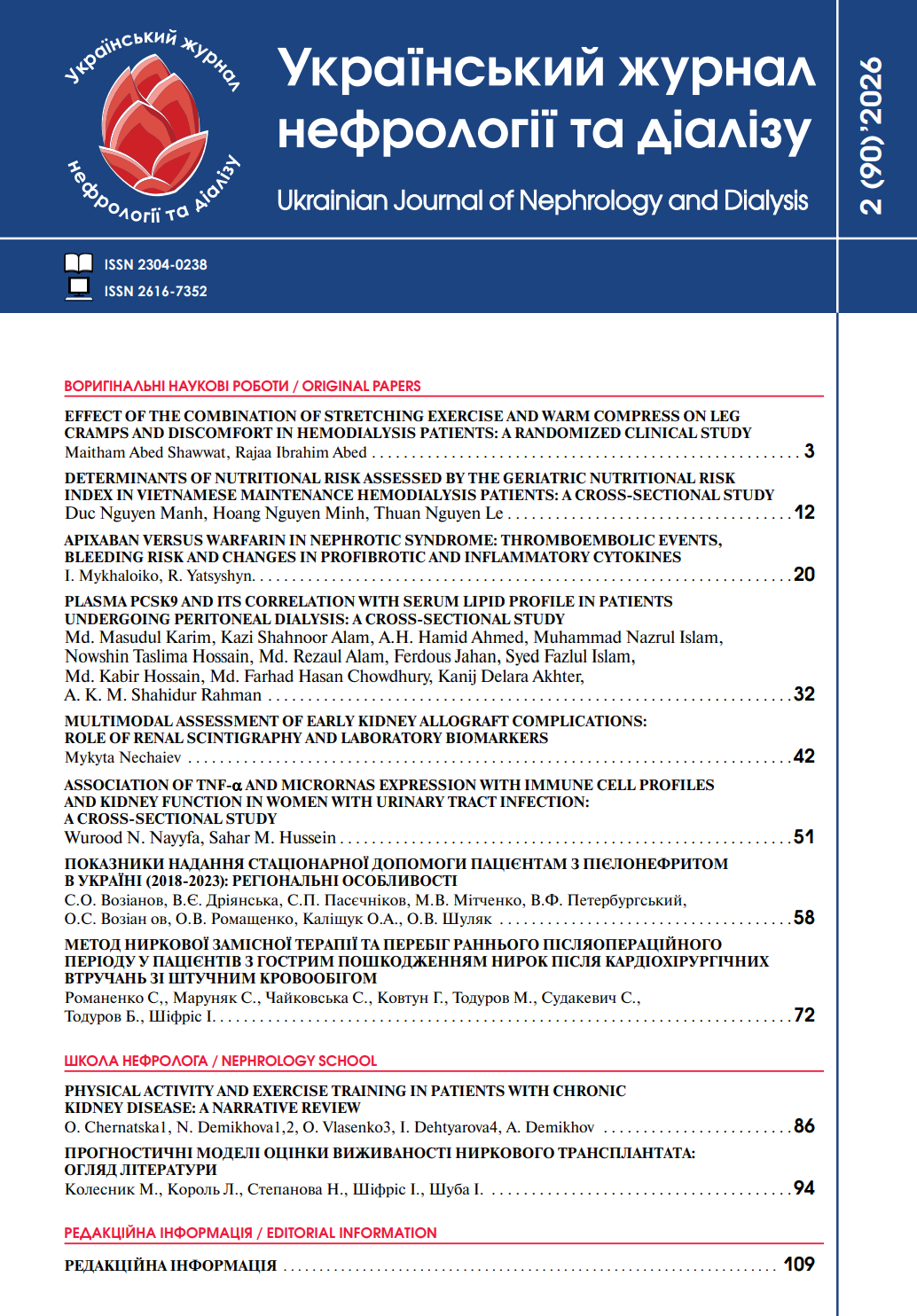
Multimodal assessment of early kidney allograft complications: Role of renal scintigraphy and laboratory biomarkers

  • Mykyta Nechaiev State Non-Commercial Enterprise «National Children's Specialized Hospital «Okhmatdyt» Ministry of Health of Ukraine», Kyiv, Ukraine; Bogomolets National Medical University, Kyiv, Ukraine https://orcid.org/0000-0002-7345-5124
Keywords: kidney transplantation, postoperative complications, radioisotope renography, technetium tc 99m pentetate, perfusion index, functional index, glomerular filtration rate, delayed graft function, graft rejection.

Abstract

Early post-transplant complications remain a major challenge in kidney transplantation. It reveals an overlap of clinical manifestations and the limited specificity of routine laboratory markers may delay diagnosis. Functional renal scintigraphy provides a quantitative assessment of graft perfusion and function and may improve early detection of allograft dysfunction.

Objective. To evaluate the predictive value of scintigraphy, clinical and laboratory parameters for early post-transplant complications in kidney transplant recipients.

Methods. This single-center observational study included 65 kidney transplant recipients who underwent 99mTc-DTPA renal scintigraphy within 1-7 days after transplantation. Conventional laboratory markers (serum creatinine, blood urea, white blood cell count, erythrocyte sedimentation rate, platelet count) and scintigraphy indices, including perfusion index (PI), functional index (FI), and glomerular filtration rate (GFR), were analyzed. Patients were classified into stable graft function and complication groups. Statistical analysis included multivariable logistic regression, receiver operating characteristic (ROC) analysis, and principal component analysis (PCA).

Results. Thirty-three patients (50.8%) developed early post-transplant complications. Serum creatinine and platelet count were significantly higher in the complication group (p < 0.05). Multivariable regression identified serum creatinine, ESR, PI, FI and GFR as independent predictors of complications, with GFR demonstrating the strongest inverse association (p<0.0001). ROC analysis showed good diagnostic performance for PI (AUC 0.78-0.82), FI (AUC 0.75-0.80), and GFR (AUC 0.73-0.78). PCA demonstrated clustering of scintigraphy indices with markers of graft dysfunction and inflammation, supporting their complementary diagnostic value.

Conclusions. Functional renal parameters, particularly PI, FI and GFR, provide significant predictive value for early kidney allograft complications and outperform routine laboratory markers when used in isolation. An integrated approach combining laboratory and scintigraphy assessment may improve early risk stratification and guide timely clinical interventions in the post-transplant period.

Downloads

Download data is not yet available.

References

Awan A, Riordan M. End-stage renal disease and renal transplantation. Book Chapter: P. Puri, ME. Höllwarth (Eds.), Pediatric surgery. Diagnosis and Management. Springer. 2023. pp. 1377-88. doi: 10.1007/978-3-030-81488-5_99.

Nechaiev MP. Renal scintigraphy of the transplanted kidney: Innovative approaches to monitoring and prognostic value. Ukr J Nephrol Dialys. 2025;4(88):63-71. doi: 10.31450/ukrjnd.4(88).2025.08.

Singh G, Gaillard F, Pringle M, et al. Renal transplant (complications). Radiopaedia.org 2026. https://doi.org/10.53347/rID-99.
Lee P-H, Huang SM, Tsai Y-C, Wang Y-T, Chew FY. Biomarkers in contrast-induced nephropathy: Advances in early detection, risk assessment, and prevention strategies. International Journal of Molecular Sciences. 2025;26(7): Article 2869. doi: 10.3390/ijms26072869.

Carraro A, De Gaspari P, Antoniello B, Marzenta D, Vianello E, Bussolati B., (2024). New insights into pediatric kidney transplant rejection biomarkers: Tissue, plasma and urine microRNAs compared to protocol biopsy histology. International Journal of Molecular Science. 2024;25(3):Article 1911. doi: 10.3390/ijms25031911.

Quaglia M, Merlotti G, Guglielmetti G, Castellano G, Cantaluppi V. Recent advances on biomarkers of early and late kidney graft dysfunction. Int J Mol Sci. 2020;21(15):Article 5404. doi: 10.3390/ijms21155404.

Lazarou C, Moysidou E, Christodoulou M, Lioulios G, Sampani E, Dimitriadis C, et al. Non-invasive biomarkers for early diagnosis of kidney allograft dysfunction: Current and future applications in the era of precision medicine. Medicina (Kaunas). 2025;61(2):262. doi: 10.3390/medicina61020262.

Lim JH, Chung BH, Lee SH, Jung HY, Choi JY, Cho JH, et al. Omics-based biomarkers for diagnosis and prediction of kidney allograft rejection. Korean J Intern Med. 2022;37(3):520-533. doi: 10.3904/kjim.2021.518.

Hu XJ, Zheng J, Li Y, Tian XH, Tian PX, Xiang HL, et al. Prediction of kidney transplant outcome based on different DGF definitions in Chinese deceased donation. BMC Nephrol. 2019;20(1):409. doi: 10.1186/s12882-019-1557-x.

Benjamens S, Berger SP, Glaudemans AWJM, Sanders JSF, Pol RA, Slart RHJA. Renal scintigraphy for post-transplant monitoring after kidney transplantation. Transplant Rev (Orlando). 2018;32(2):102-109. doi: 10.1016/j.trre.2017.12.002.

Kohli R, Platton S, Forbes S, Thuraisingham R, Tan J, Green L, et al. Renal transplant and hemostasis: Early postoperative changes in recipients and donors. Res Pract Thromb Haemost. 2023;7(4):100168. doi: 10.1016/j.rpth.2023.100168.

Strader M, Kant S. Novel biomarkers for rejection in kidney transplantation: A comprehensive review. J Clin Med. 2025;14(15):5489. doi: 10.3390/jcm14155489.

Ghonge NP, Goyal N, Vohra S, Chowdhury V. Renal transplant evaluation: Multimodality imaging of post-transplant complications. Br J Radiol. 2021;94(1124):20201253. doi: 10.1259/bjr.20201253.

Ale Ali H, Scherer P. Renal scintigraphy following kidney transplantation – ATN, rejection, and more. J Nucl Med. [Internet]. 2022; 63 (Suppl. 2): 2668. Available from: https://jnm.snmjournals.org/content/63/supplement_2/2668.


Abstract views: 68
PDF Downloads: 40
Published
2026-06-11
How to Cite
Nechaiev, M. (2026). Multimodal assessment of early kidney allograft complications: Role of renal scintigraphy and laboratory biomarkers . Ukrainian Journal of Nephrology and Dialysis, (2(90), 42-50. https://doi.org/10.31450/ukrjnd.2(90).2026.05