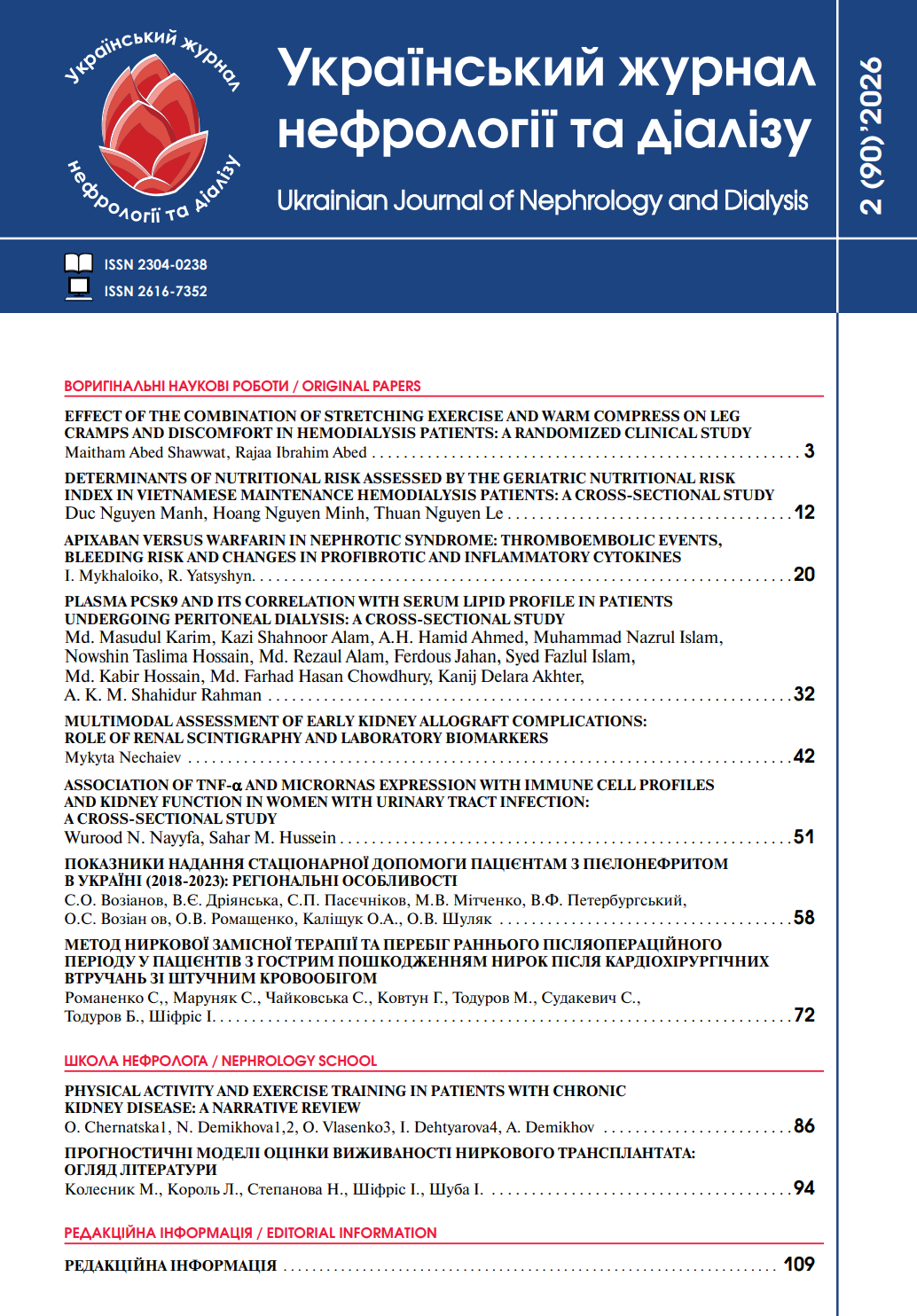
Plasma PCSK9 and its correlation with serum lipid profile in patients undergoing peritoneal dialysis: A cross-sectional study
Abstract
Peritoneal dialysis (PD) is a widely practiced treatment option for patients with chronic kidney disease (CKD). Patients undergoing PD have lipid abnormalities that pose a significant cardiovascular risk. Elevated Proprotein Convertase Subtilisin/Kexin Type 9 (PCSK9) levels in these patients may worsen their lipid dysregulation. However, limited data are available on PCSK9 concentration in PD patients. The present study aimed to examine the correlation between plasma PCSK9 and serum lipid profile in patients on PD.
Methods. In this cross-sectional study, a total of 160 participants were included following the selection criteria. Of them, 80 were CKD patients on PD (Group A) and rest 80 were apparently healthy subjects as controls (Group B). Fasting serum lipid profile, serum albumin, serum creatinine, urinary protein creatinine ratio (UPCR), and plasma PCSK9 levels of all participants were measured. Additionally, PD adequacy parameters (Kt/V urea, creatinine clearance, residual renal function, transport status) were recorded for PD patients.
Results. PD patients had significantly high levels of total cholesterol (TC), low-density lipoprotein (LDL) cholesterol, and triglyceride (TG) compared to controls (p<0.001). PD patients exhibited a significantly elevated level of PCSK9 than controls (p<0.001). In PD patients, PCSK9 had a significant positive correlation with TC (r= 0.713, p<0.001) and LDL cholesterol (r= 0.747, p<0.001). TC (>200 mg/dL) and LDL cholesterol (>130 mg/dL) were significant predictors of elevated PCSK9 levels. A cut-off value of PCSK9 >125.3 ng/ml was significantly associated with dyslipidemia in PD patients, with a sensitivity and specificity were 85.0% and 87.5%.
Conclusions. Serum TC, LDL cholesterol, and TG levels are considerably higher in PD patients compared to healthy controls. Patients receiving peritoneal dialysis also had significantly elevated plasma PCSK9 levels. Plasma PCSK9 was positively associated with TC and LDL cholesterol. TC and LDL cholesterol were independent predictors of elevated plasma PCSK9 levels in patients undergoing peritoneal dialysis.
Downloads
References
Copyright (c) 2026 Ukrainian Journal of Nephrology and Dialysis

This work is licensed under a Creative Commons Attribution-ShareAlike 4.0 International License.


