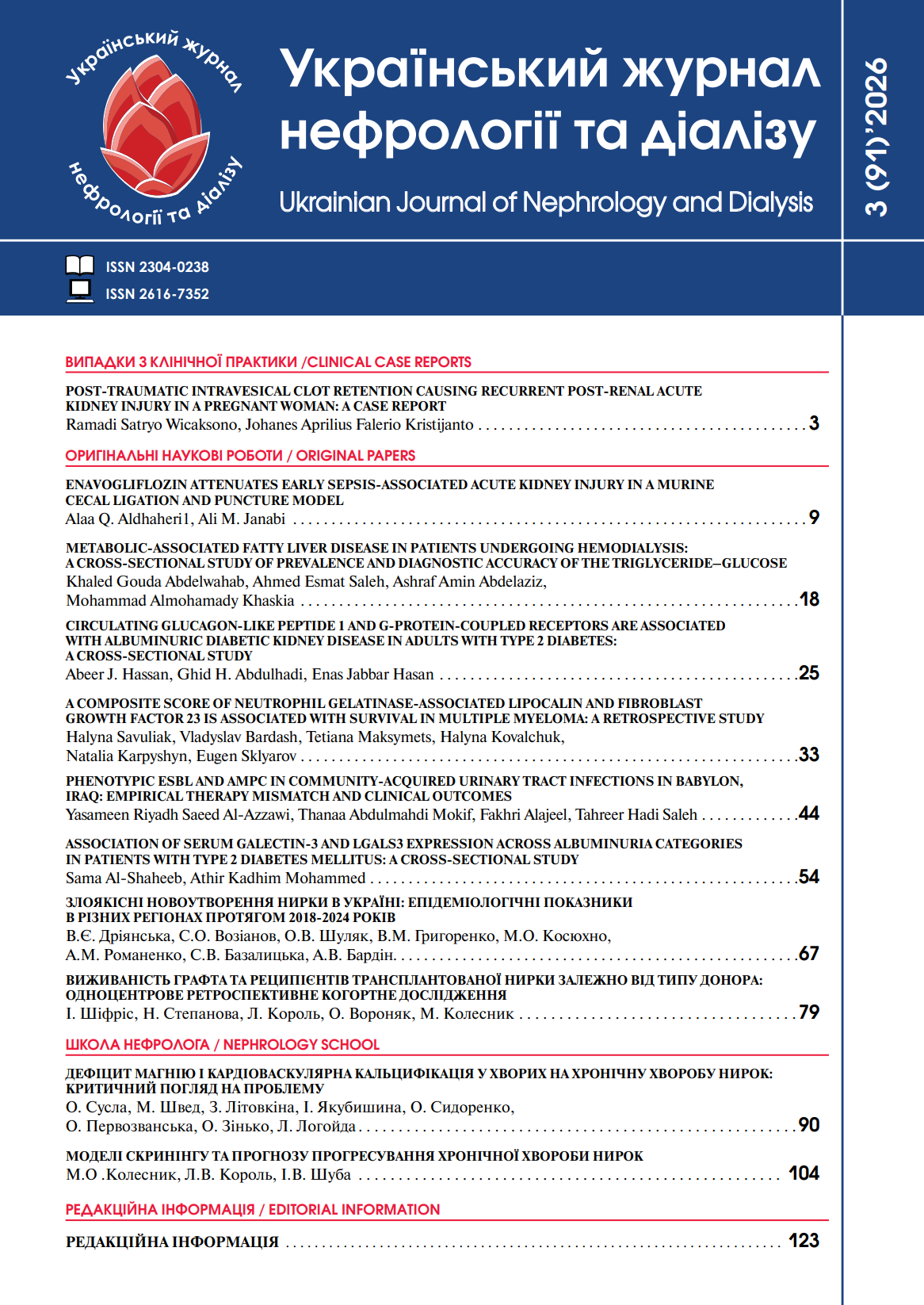
Phenotypic ESBL and AmpC in community-acquired urinary tract infections in Babylon, Iraq: Empirical therapy mismatch and clinical outcomes

Keywords: urinary tract infections, community-acquired infections, beta-lactamases, drug resistance, Escherichia coli, Klebsiella pneumoniae, treatment failure, recurrence.

Abstract

Community-acquired urinary tract infections (UTI) are commonly treated empirically before culture and susceptibility results are available. The rising prevalence of extended-spectrum beta-lactamase (ESBL) and AmpC beta-lactamase phenotypes in uropathogens could lead to decreased effectiveness of empiric treatment and higher incidence of treatment failure and recurrence. The present study was carried out to investigate the prevalence of phenotypic ESBL and AmpC-producing community-acquired UTIs caused by E. Coli and K. Pneumoniae in Babylon, Iraq, and to determine their association with empirical therapy mismatch and clinical outcomes.

Methods. This multicenter observational cohort study included 150 episodes of symptomatic community-acquired UTIs caused by E. coli or K. pneumoniae. ESBL and AmpC production were detected phenotypically. Empirical therapy mismatch was defined as initial antibiotic therapy that was inactive against the isolated organism according to susceptibility testing. Outcomes included treatment failure within 14 days and recurrence within 30 and 90 days. Logistic regression was used to assess predictors of empirical therapy mismatch and treatment failure.

Results. ESBL production was detected in 44 isolates (29.3%), AmpC production in 16 isolates (10.7%), and ESBL and/or AmpC positivity in 54 isolates (36.0%). Six isolates were positive for both ESBL and AmpC phenotypes. Multidrug resistance was detected in 48 isolates (32.0%). Empirical therapy mismatch occurred in 42 episodes (28.0%). In multivariable logistic regression, ESBL phenotype was independently associated with empirical therapy mismatch (aOR 4.10, 95% CI 1.90–8.90; p < 0.001), as was prior antibiotic exposure within 90 days (aOR 2.05, 95% CI 1.00–4.20; p = 0.049). Empirical therapy mismatch was independently associated with treatment failure within 14 days (aOR 3.02, 95% CI 1.20–7.60; p = 0.019). ESBL/AmpC-positive infections also showed higher rates of treatment failure, antibiotic escalation, and recurrence.

Conclusions. Phenotypic ESBL and AmpC production were common among community-acquired E. coli and K. pneumoniae urinary isolates in Babylon, Iraq. Empirical therapy mismatch occurred in more than one-quarter of cases and was associated with poorer short-term outcomes. Our findings support local antibiogram-guided, risk-stratified empirical therapy with early culture-directed adjustment.

Downloads

Download data is not yet available.

References

Que AT, Tran AD, Trang THN, Tran TNL, Bui NN, Lai CH. Epidemiology and antimicrobial resistance patterns of urinary tract infection: insights and strategies from a 5-year serial cross-sectional study in Vietnam. Ther Adv Infect Dis. 2025;12:20499361251315346. doi: 10.1177/20499361251315346.

NkontCho F, Sainte-Rose V, Abboud P, Portecop P, Pujo JM, Cook F, et al. Antimicrobial susceptibility of community-acquired urine bacterial isolates in French Amazonia. Am J Trop Med Hyg. 2023;108(5):927-35. doi: 10.4269/ajtmh.22-0242.

Al-Yousif AI, Al-Darwish SA, Fawzi F, Ahmed AG. Comparison of ethanolic and ethyl acetate fractions of Iraqi Medicago sativa for the treatment of urinary tract infection. Ukr J Nephrol Dial. 2025;2(86):3-13. doi: 10.31450/ukrjnd.2(86).2025.01.

Aththanayaka AMWGKP, Weerasinghe GGYH, Weerakkody NS, Samarasinghe SHGG, Priyadharshana U. Effectiveness of selective antibiotics use in ESBL-related UTIs. BMC Microbiol. 2024;24(1):360. doi: 10.1186/s12866-024-03495-y.

Shao F, Li D, Wang J, Tuo Z, Wang Z, Wei W, et al. Beta-lactamase-mediated antibiotic resistance in urinary tract infections: mechanisms and therapeutic strategies. Urogenital Tract Infection. 2025;20(2):67-81. doi: 10.14777/uti.2550012006.

Jomehzadeh N, Ahmadi K, Rahmani Z. Prevalence of plasmid-mediated AmpC β-lactamases among uropathogenic Escherichia coli isolates in southwestern Iran. Osong Public Health Res Perspect. 2021;12(6):390-95. doi: 10.24171/j.phrp.2021.0272.

Dunne MW, Puttagunta S, Aronin SI, Brossette S, Murray J, Gupta V. Impact of empirical antibiotic therapy on outcomes of outpatient urinary tract infection due to nonsusceptible Enterobacterales. Microbiol Spectr. 2022;10(1):e0235921. doi: 10.1128/spectrum.02359-21.

Mohammed OA, Abubakr KT, Yaghoobi A, Khdhir HH, Ali DH, Abdalrahman PK, et al. Microbial prevalence and understanding of their antimicrobial susceptibility in urinary tract of patients attending at Shar Teaching Hospital (2018–2022). BMC Res Notes. 2025;18(1):329. doi: 10.1186/s13104-025-07361-6.

Husna A, Rahman MM, Badruzzaman ATM, Sikder MH, Islam MR, Rahman MT, et al. Extended-spectrum β-lactamases (ESBL): challenges and opportunities. Biomedicines. 2023;11(11):2937. doi: 10.3390/biomedicines11112937.

Ibrahim DR, Dodd CER, Stekel DJ, Meshioye RT, Diggle M, Lister M, et al. Multidrug-resistant ESBL-producing E. coli in clinical samples from the UK. Antibiotics (Basel). 2023;12(1):169. doi: 10.3390/antibiotics12010169.

Castanheira M, Simner PJ, Bradford PA. Extended-spectrum β-lactamases: an update on their characteristics, epidemiology and detection. JAC Antimicrob Resist. 2021;3(3):dlab092. doi: 10.1093/jacamr/dlab092.

Kwon KT, Kim Y, Kim SW, Chang HH, Hwang S, Bae S, et al. Antimicrobial use and carbapenem-resistant Enterobacterales in Korea: a nationwide case-control study with propensity score matching. J Korean Med Sci. 2024;39(14):e132. doi: 10.3346/jkms.2024.39.e132.

Alshaikh A, Kubas M. Empirical antibiotic use, resistance patterns, and their impact on clinical outcomes in a Yemeni tertiary hospital. New Microbes New Infect. 2026;70:101723. doi: 10.1016/j.nmni.2026.101723.

Mahdizade Ari M, Dashtbin S, Ghasemi F, Shahroodian S, Kiani P, Bafandeh E, et al. Nitrofurantoin: properties and potential in treatment of urinary tract infection: a narrative review. Front Cell Infect Microbiol. 2023;13:1148603. doi: 10.3389/fcimb.2023.1148603.

Yamin D, Uskoković V, Wakil AM, Goni MD, Shamsuddin SH, Mustafa FH, et al. Current and future technologies for the detection of antibiotic-resistant bacteria. Diagnostics (Basel). 2023;13(20):3246. doi: 10.3390/diagnostics13203246.

Ibrahim GJ, Laftaah BA. The Efficiency of Certain Amino Acids in regulating chABCI Gene Expression in Proteus mirabilis. Iraqi Journal of Science. 2024; 56(9). doi: 10.24996/ijs.2024.65.9.15.

Abdullah MM, AL-Rubaii BAL. Effect of Lactobacillus supernatant on swarming-related gene expression in Proteus mirabilis isolated from urinary tract infections. Ukr J Nephrol Dial. 2024;4(84):39-48. doi: 10.31450/ukrjnd.4(84).2024.05.

Al-Khafaji ZH, AlMaathidy NG, Al-Shahery YJ, Nadhim RA. Estimation of biological nitrogen fixation by genetically characterized local strains of cyanobacteria. Journal of Ecological Engineering. 2025;26(3):257-63. doi: 10.12911/22998993/199726.

Jassim TS, Al-Fendi AM, Hashim ST, Saleh TH, Al-Rubaii BA. Molecular detection of Rubella virus (1E genotype) in clinical sample of pregnant women, and it’s related to abortion. Reproductive Health of Woman. 2025;23(3):113-18. doi: 10.30841/2708-8731.3.2025.331563.

Jassim TS, Talib SS, Jaber NR, Sahib DH, Ali RW, Al-Rubaii B. Impact of hepatitis C virus on IFITM3 gene expression: A comprehensive analysis incorporating serological detection and viral load quantification via qPCR. Polim Med. 2025;55(1):21-30. doi: 10.17219/pim/199333.

Khalaf ZA, Al-Bashar SH, Ibrahim TK, Al-Rubaii BA. The correlation among IL-37, IL-6, and IL-10 gene expression in patients infected with Helicobacter pylori. East Ukr Med J. 2025;13(1):103-110. doi: 10.21272/eumj.2025;13(1):103-110.

Hallab NS, Mohammed RA, Rasheed IAAM, AL-Rubaii BAL. The potential impact of vitamin D on the reduction of C-reactive protein (CRP) levels in patients infected with COVID-19. East Ukr Med J. 2025;13(2):544-550. doi: 10.21272/eumj.2025;13(2):544-550.

Husain AG, Alrubaii BA. Molecular detection and expression of virulence factor encoding genes of Pseudomonas aeruginosa isolated from clinical samples. Biomedicine. 2023;43(5):1514-9. doi: 10.51248/.v43i5.3263.

Mohammed IS, Al-Bayati A, Hashim ST, Saleh TH, Laftaah BA, Hasoon BA. The effect of zinc oxide on inhibition of Candida albicans isolated from leukemia patients. Microbial Biosystems. 2025;10(2):202-212. doi: 10.21608/mb.2025.366586.1265.

Khudair S, Al Rasheed IA, Ibrahim TK, Saleh TH, Al-Rubaii BA. Molecular study of CACNA1A, ATP1A2, and SCN1A genes and its association with the migraine disease in Iraq. Ibom Med J. 2026;19(1):132-43. doi: 10.61386/imj.v19i1.922.

Hasan AS, Al-Rubaii BAL. Exploring the role of miRNA-9 and HLA-Class I expression in burn-induced vitiligo: the interplay of immune response and bacterial infections. Iraqi J Sci. 2026;67(4):2212-25. doi: 10.24996/ijs.2026.67.4.25.


Abstract views: 4
PDF Downloads: 0
Published
2026-08-27
How to Cite
Al-Azzawi, Y. R. S., Mokif, T. A., Alajeel, F., & Saleh, T. H. (2026). Phenotypic ESBL and AmpC in community-acquired urinary tract infections in Babylon, Iraq: Empirical therapy mismatch and clinical outcomes. Ukrainian Journal of Nephrology and Dialysis, (3(91), 45-53. https://doi.org/10.31450/ukrjnd.3(91).2026.06