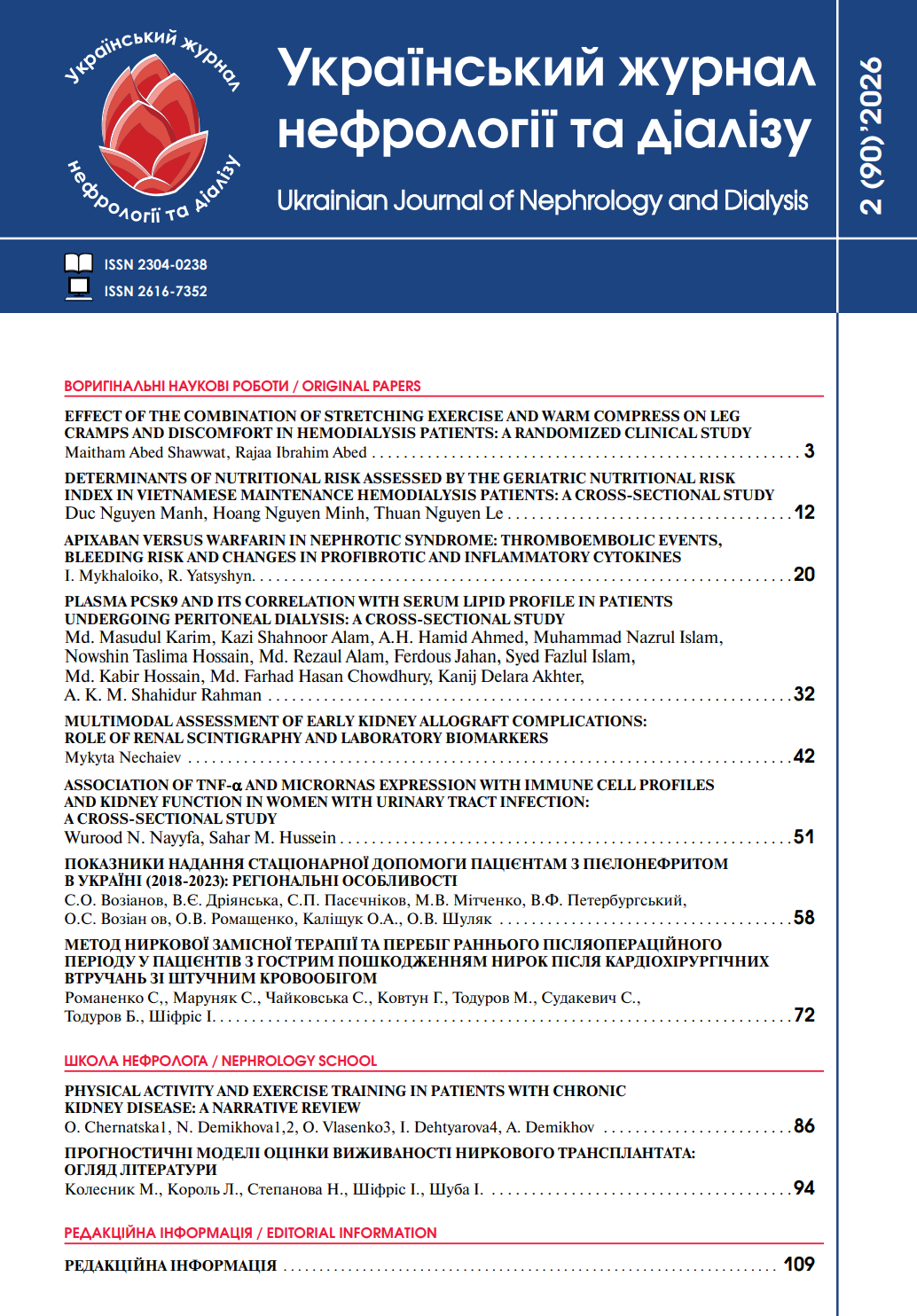
Methods of renal replacement therapy and the course of the early postoperative period in patients with acute kidney injury following cardiac surgery involving cardiopulmonary bypass
Abstract
Acute kidney injury (AKI) following cardiac surgery involving cardiopulmonary bypass is associated with increased mortality and prolonged intensive care unit (ICU) stays. The optimal choice of modality and regimen for renal replacement therapy (RRT) remains a matter of debate.
The aim of the study was to assess the incidence of AKI in patients following cardiac surgery and the impact of different RRT methods on the course of the early postoperative period in this patient group.
Methods. A total of 5,289 patients who underwent cardiac surgery between 2022 and 2025 were included in the retrospective study. AKI was defined according to KDIGO criteria. All adult patients requiring dialysis treatment were divided into groups based on the modality and regimen of RRT: intermittent haemodialysis (IHD, n=20), slow low-efficiency dialysis (SLED, n=21) and continuous renal replacement therapy (CRRT, n=17). The primary endpoint of the study was in-hospital mortality.
Results. Of the total number of patients who underwent cardiac surgery, acute kidney injury (AKI) developed in 1,358 cases (25.7%), of whom 58 (4.27%) required treatment with continuous renal replacement therapy. The patient groups were representative in terms of demographic, laboratory and intraoperative characteristics. In the CRRT group, compared with the IHD and SLED groups, a significantly faster normalisation of creatinine and lactate was observed (p<0.05 on days 1–14), more stable mean arterial pressure (p=0.032–0.041), lower requirement for invasive support (12.9±5.8 vs 21.3±7.5 in the IHD group and 18.1±6.8 in the SLED group; p=0.013) and duration of mechanical ventilation (CRRT – 34 [24–60] hours vs 68 [42–110] in IHD and 52 [36–88] in SLED; p=0.018). Furthermore, patients in the CRRT group had shorter lengths of stay in the ICU (10 [4–15] days; p=0.048) and overall hospitalisation (19 [11–29] days; p=0.028).
In the CRRT group, in-hospital mortality was 23.5% compared with 45.0% in the IHD group and 38.1% in the SLED group (p=0.372); however, in multivariate analysis, CRRT treatment was significantly associated with a reduced risk of death (OR 0.50; 95% CI 0.23–0.99; p=0.048). Independent predictors of mortality were lactate, MODS, duration of mechanical ventilation, sepsis and maximum VIS.
Conclusions. The incidence of acute kidney injury (AKI) in patients following cardiac surgery involving cardiopulmonary bypass was 25.7%; one in every four to five (4.27%) patients with AKI required renal replacement therapy. Compared with other methods, CRRT is associated with better early outcomes regarding the course of the early postoperative period and a reduced risk of mortality after adjustment for disease severity, particularly in haemodynamically unstable patients.
Downloads
References
Copyright (c) 2026 Ukrainian Journal of Nephrology and Dialysis

This work is licensed under a Creative Commons Attribution-ShareAlike 4.0 International License.


