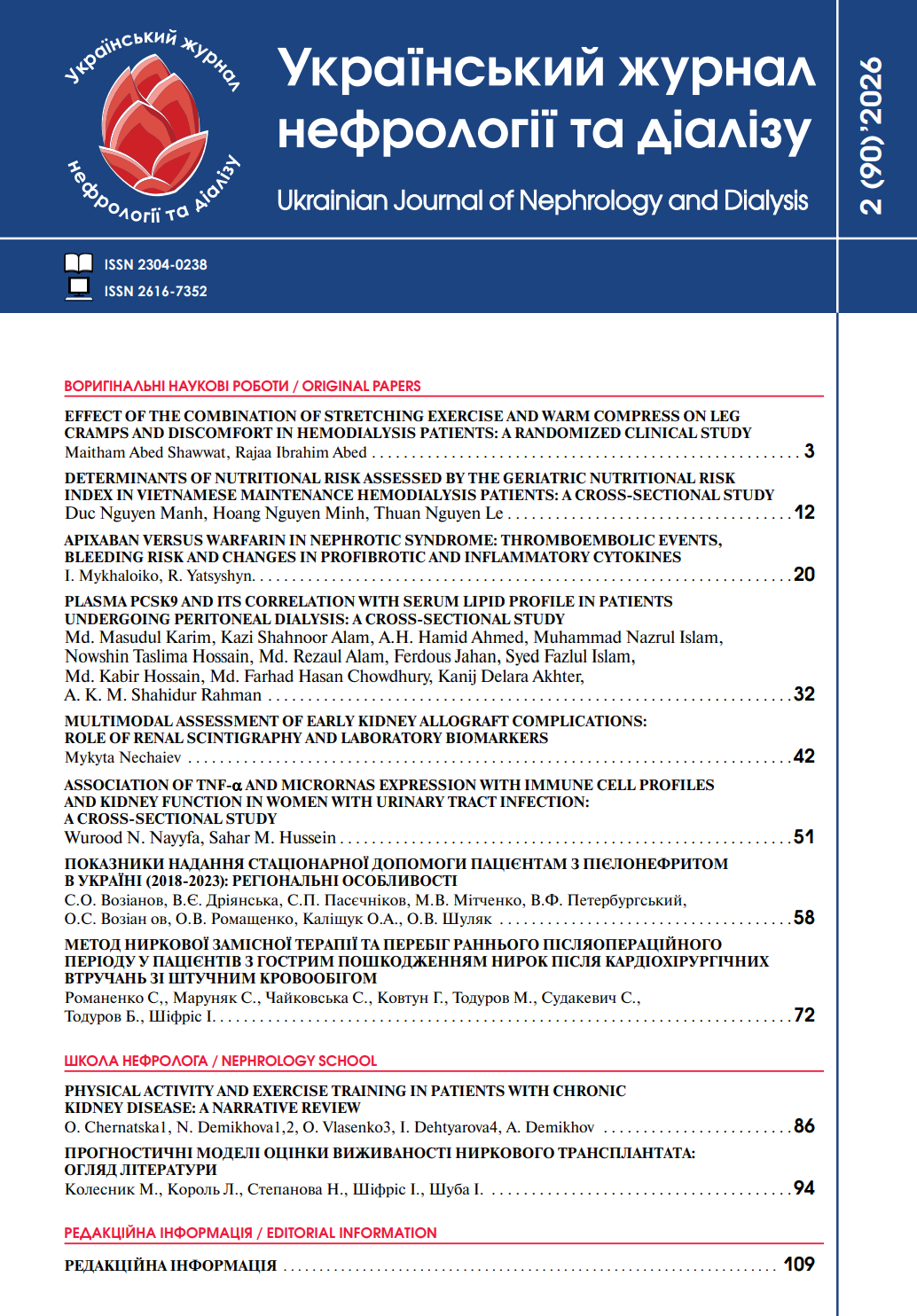
Methods of renal replacement therapy and the course of the early postoperative period in patients with acute kidney injury following cardiac surgery involving cardiopulmonary bypass

Keywords: acute kidney injury, cardiac surgery, renal replacement therapy, continuous renal replacement therapy (CRRT), cardiopulmonary bypass, in-hospital mortality.

Abstract

Acute kidney injury (AKI) following cardiac surgery involving cardiopulmonary bypass is associated with increased mortality and prolonged intensive care unit (ICU) stays. The optimal choice of modality and regimen for renal replacement therapy (RRT) remains a matter of debate.

The aim of the study was to assess the incidence of AKI in patients following cardiac surgery and the impact of different RRT methods on the course of the early postoperative period in this patient group.

Methods. A total of 5,289 patients who underwent cardiac surgery between 2022 and 2025 were included in the retrospective study. AKI was defined according to KDIGO criteria. All adult patients requiring dialysis treatment were divided into groups based on the modality and regimen of RRT: intermittent haemodialysis (IHD, n=20), slow low-efficiency dialysis (SLED, n=21) and continuous renal replacement therapy (CRRT, n=17). The primary endpoint of the study was in-hospital mortality.

Results. Of the total number of patients who underwent cardiac surgery, acute kidney injury (AKI) developed in 1,358 cases (25.7%), of whom 58 (4.27%) required treatment with continuous renal replacement therapy. The patient groups were representative in terms of demographic, laboratory and intraoperative characteristics. In the CRRT group, compared with the IHD and SLED groups, a significantly faster normalisation of creatinine and lactate was observed (p<0.05 on days 1–14), more stable mean arterial pressure (p=0.032–0.041), lower requirement for invasive support (12.9±5.8 vs 21.3±7.5 in the IHD group and 18.1±6.8 in the SLED group; p=0.013) and duration of mechanical ventilation (CRRT – 34 [24–60] hours vs 68 [42–110] in IHD and 52 [36–88] in SLED; p=0.018). Furthermore, patients in the CRRT group had shorter lengths of stay in the ICU (10 [4–15] days; p=0.048) and overall hospitalisation (19 [11–29] days; p=0.028).

In the CRRT group, in-hospital mortality was 23.5% compared with 45.0% in the IHD group and 38.1% in the SLED group (p=0.372); however, in multivariate analysis, CRRT treatment was significantly associated with a reduced risk of death (OR 0.50; 95% CI 0.23–0.99; p=0.048). Independent predictors of mortality were lactate, MODS, duration of mechanical ventilation, sepsis and maximum VIS.

Conclusions. The incidence of acute kidney injury (AKI) in patients following cardiac surgery involving cardiopulmonary bypass was 25.7%; one in every four to five (4.27%) patients with AKI required renal replacement therapy. Compared with other methods, CRRT is associated with better early outcomes regarding the course of the early postoperative period and a reduced risk of mortality after adjustment for disease severity, particularly in haemodynamically unstable patients.


Downloads

Download data is not yet available.

References

Boyer N, Eldridge J, Prowle JR, Forni LG. Postoperative acute kidney injury. Clin J Am Soc Nephrol. 2022;17(10):1535–45. doi: 10.2215/CJN.16541221.

Wang Y, Bellomo R. Cardiac surgery-associated acute kidney injury: risk factors, pathophysiology and treatment. Nat Rev Nephrol. 2017;13(11):697-11. doi: 10.1038/nrneph.2017.119.

Peerapornratana S, Manrique-Caballero CL, Gomez H, Kellum JA. Acute kidney injury from sepsis: current concepts, epidemiology, pathophysiology, prevention and treatment. Kidney Int. 2019;96(5):1083-99. doi: 10.1016/j.kint.2019.05.026.

Scurt FG, Bose K, Mertens PR, Chatzikyrkou C, Herzog C. Cardiac Surgery-Associated Acute Kidney Injury. Kidney360. 2024;5(6):909-26. doi: 10.34067/KID.0000000000000466.

Bagshaw SM, Neto AS, Smith O, Weir M, Qiu H, Du B, et al.; STARRT-AKI Investigators. Impact of renal-replacement therapy strategies on outcomes for patients with chronic kidney disease: a secondary analysis of the STARRT-AKI trial. Intensive Care Med. 2022;48(12):1736-50. doi: 10.1007/s00134-022-06912-w.

Kellum JA, Prowle JR. Paradigms of acute kidney injury in the intensive care setting. Nat Rev Nephrol. 2018;14(4):217-30. doi: 10.1038/nrneph.2017.184.

Maruniak S, Loskutov O, Swol J, Todurov B. Factors associated with acute kidney injury after on-pump coronary artery bypass grafting. J Cardiothorac Surg. 2024;19(1):598. doi: 10.1186/s13019-024-03103-0.

Nash DM, Przech S, Wald R, O'Reilly D. Systematic review and meta-analysis of renal replacement therapy modalities for acute kidney injury in the intensive care unit. J Crit Care. 2017;41:138-44. doi: 10.1016/j.jcrc.2017.05.002.

An JN, Kim SG, Song YR. When and why to start continuous renal replacement therapy in critically ill patients with acute kidney injury. Kidney Res Clin Pract. 2021;40(4):566-77. doi: 10.23876/j.krcp.21.043.

Clark E, Wald R, Walsh M, Bagshaw SM, Canadian Acute Kidney Injury (CANAKI) Investigators. Timing of initiation of renal replacement therapy for acute kidney injury: a survey of nephrologists and intensivists in Canada. Nephrol Dial Transplant. 2012;27:2761-67. doi: 10.1093/ndt/gfr740.

Gaudry S, Grolleau F, Barbar S, Martin-Lefevre L, Pons B, Boulet É, et al. Continuous renal replacement therapy versus intermittent hemodialysis as first modality for renal replacement therapy in severe acute kidney injury: a secondary analysis of AKIKI and IDEAL-ICU studies. Crit Care. 2022;26(1):93. doi: 10.1186/s13054-022-03955-9.

Vinsonneau C, Camus C, Combes A, Costa de Beauregard MA, Klouche K, Boulain T, et al. Continuous venovenous haemodiafiltration versus intermittent haemodialysis for acute renal failure in patients with multiple-organ dysfunction syndrome: a multicentre randomised trial. Lancet. 2006;368(9533):379-85. doi: 10.1016/S0140-6736(06)69111-3.

Zakon K, Romanova V, Dudarenko V, Arbuzova I, Radchenko G. Differential approach of continuous and intermittent renal replacement therapy applying in cardiac surgery acute kidney injury. Ukr J Nephrol Dial. 2016;0(1(49):46-2. doi: 10.31450/ukrjnd.1(49).2016.04.

Kellum JA, Angus DC, Johnson JP, Leblanc M, Griffin M, Ramakrishnan N, et al. Continuous versus intermittent renal replacement therapy: a meta-analysis. Intensive Care Med. 2002;28(1):29-37. doi: 10.1007/s00134-001-1159-4.

Truche AS, Darmon M, Bailly S, Clec'h C, Dupuis C, Misset B, et al. OUTCOMEREA Study Group. Continuous renal replacement therapy versus intermittent hemodialysis in intensive care patients: impact on mortality and renal recovery. Intensive Care Med. 2016;42(9):1408-17. doi: 10.1007/s00134-016-4404-6.

Valdenebro M, Martín-Rodríguez L, Tarragón B, Sánchez-Briales P, Portolés J. Renal replacement therapy in critically ill patients with acute kidney injury: 2020 nephrologist's perspective. Nefrologia (Engl Ed). 2021;41(2):102-14. English, Spanish. doi: 10.1016/j.nefro.2020.07.016.

Erdélyi L, Trásy D. CRRT Is More Than Just Continuous Renal Replacement Therapy. Pharmaceuticals (Basel). 2024;17(12):1571. doi: 10.3390/ph17121571.

Zarbock A, Nadim MK, Pickkers P, Gomez H, Bell S, Joannidis M, et al. Sepsis-associated acute kidney injury: consensus report of the 28th Acute Disease Quality Initiative workgroup. Nat Rev Nephrol. 2023;19(6):401-17. doi: 10.1038/s41581-023-00683-3.

Ranucci M, Johnson I, Willcox T, Baker RA, Boer C, Baumann A, Justison GA, et al. Goal-directed perfusion to reduce acute kidney injury: A randomized trial. J Thorac Cardiovasc Surg. 2018;156(5):1918-27.e2. doi: 10.1016/j.jtcvs.2018.04.045.

Harvey AK, Burns KEA, McArthur E, Adhikari NKJ, Li D, Kitchlu A, et al. Short-and long-term outcomes of sustained low efficiency dialysis vs continuous renal replacement therapy in critically ill patients with acute kidney injury. J Crit Care. 2021;62:76-81. doi: 10.1016/j.jcrc.2020.11.003.

Kovvuru K, Velez JCQ. Complications associated with continuous renal replacement therapy. Semin Dial. 2021;34(6):489-94. doi: 10.1111/sdi.12970.

Caires RA, Abdulkader RCRM, Costa E Silva VT, Ferreira GS, Burdmann EA, Yu L, et al. Sustained low-efficiency extended dialysis (SLED) with single-pass batch system in critically-ill patients with acute kidney injury (AKI). J Nephrol. 2016;29(3):401-9. doi: 10.1007/s40620-015-0224-y.

Strauß C, Albert F, Bormann E, Engelman DT, Bellomo R, Zarbock A; EPIS-AKI investigators. Risk factors, outcomes, and early prediction of cardiac surgery-associated acute kidney injury: a post hoc subgroup analysis of the Epidemiology of Surgery Associated Acute Kidney Injury study. Br J Anaesth. 2025;136(1):34-42. doi: 10.1016/j.bja.2025.08.043.

Rewa OG, Tolwani A, Mottes T, Juncos LA, Ronco C, Kashani K, et al. ADQI Consensus Meeting Members on behalf of ADQI XXII. Quality of care and safety measures of acute renal replacement therapy: Workgroup statements from the 22nd acute disease quality initiative (ADQI) consensus conference. J Crit Care. 2019;54:52-7. doi: 10.1016/j.jcrc.2019.07.003.


Abstract views: 64
PDF Downloads: 47
Published
2026-06-12
How to Cite
Romanenko, S., Marunyak, S., Chaikovska, S., Kovtun, G., Todurov, M., Sudakevych, S., Todurov, B., & Shifris, I. (2026). Methods of renal replacement therapy and the course of the early postoperative period in patients with acute kidney injury following cardiac surgery involving cardiopulmonary bypass. Ukrainian Journal of Nephrology and Dialysis, (2(90), 72-85. https://doi.org/10.31450/ukrjnd.2(90).2026.08