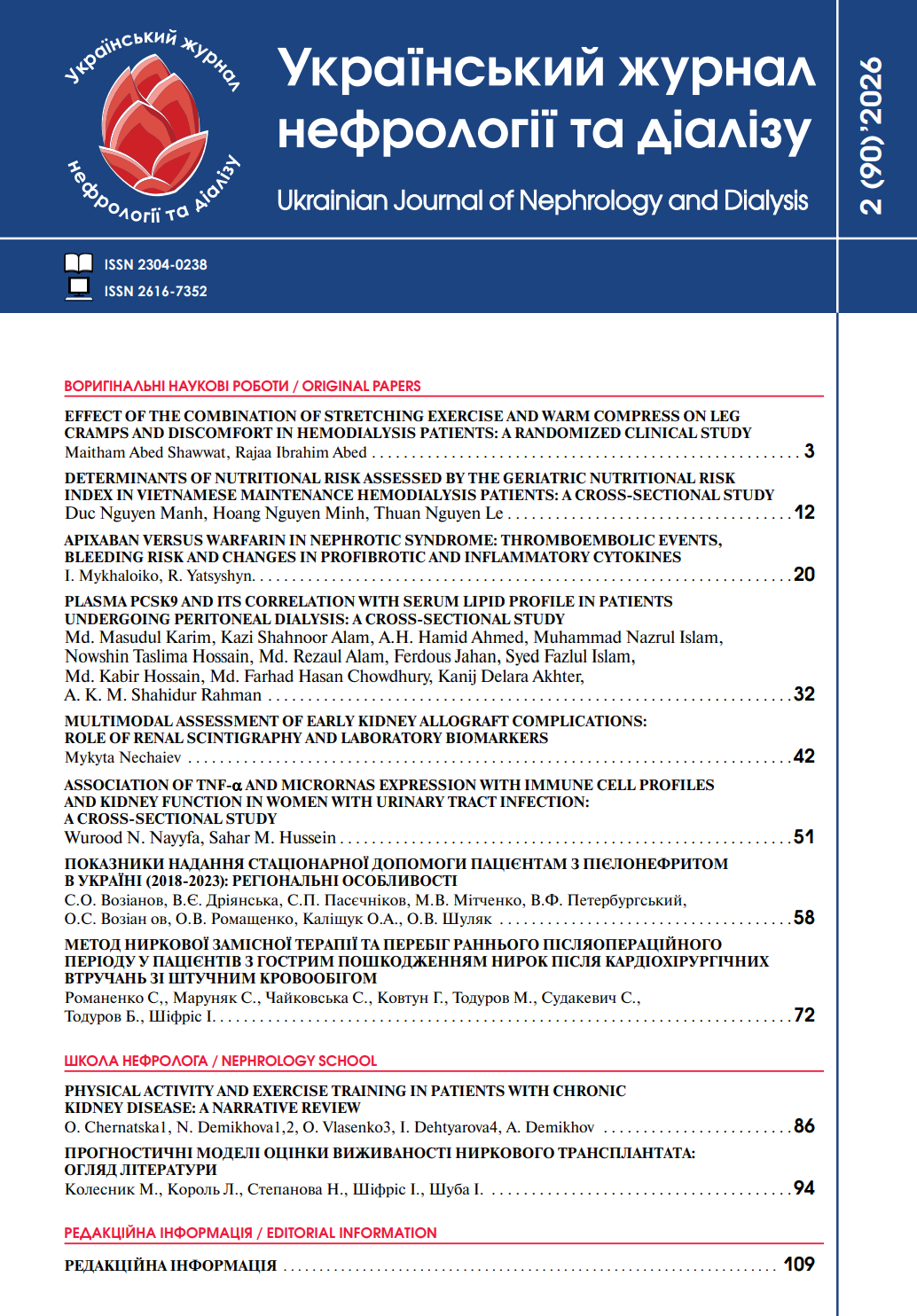
Прогностичні моделі оцінки виживаності ниркового трансплантата: огляд літератури

  • М. Колесник Державна установа «Національний науковий центр хірургії та трансплантології імені О.О. Шалімова НАМН України», Київ, Україна https://orcid.org/0000-0001-6658-3729
  • Л. Король Державна установа «Національний науковий центр хірургії та трансплантології імені О.О. Шалімова НАМН України», Київ, Україна https://orcid.org/0000-0002-5484-0326
  • Н. Степанова Державна установа «Національний науковий центр хірургії та трансплантології імені О.О. Шалімова НАМН України», Київ, Україна https://orcid.org/0000-0002-1070-3602
  • І. Шіфріс Державна установа «Національний науковий центр хірургії та трансплантології імені О.О. Шалімова НАМН України», Київ, Україна https://orcid.org/0000-0002-9413-7301
  • I. Шуба Навчально-науковий інститут високих технологій Київського національного університету імені Тараса Шевченка, Київ, Україна
Ключові слова: трансплантація нирки, виживаність трансплантата, відтермінована функція трансплантата, прогноз, оцінка ризику, прогностична цінність тестів, машинне навчання.

Анотація

Метою цього огляду літератури було надати клінічно орієнтовану оцінку прогностичних моделей, шкал, індексів, номограм і онлайн-калькуляторів, які запропоновані для оцінки функції та прогнозу виживаності ниркового трансплантата в різні часові періоди після трансплантації та запропонувати алгоритм їх практичного використання.

Методи. Проведено цільовий пошук у PubMed/MEDLINE, Scopus, Embase, Web of Science Core Collection, Cochrane Library та Google Scholar. Перевагу надавали первинним дослідженням з розробки або валідації моделей, клінічно доступним калькуляторам, консенсусним документам та оглядам, у яких оцінювали клінічну ефективність й обмеження прогностичних інструментів.

Результати. Прогностичні інструменти доцільно застосовувати відповідно до часової точки: до трансплантації - індекси донора та реципієнта; у періопераційному періоді - маркери ранньої функції й калькулятори ВФТ; протягом першого року - рШКФ, протеїнурію, біопсійні та імунологічні маркери; після першого року - композитні й динамічні моделі.

Висновки. Всі запропоновані прогностичні інструменти є допоміжними для прийняття клінічного рішення, яке має створюватись на основі поєднання рутинних маркерів  з даними моделювання.

Завантаження

Дані завантаження ще не доступні.

Посилання

Diebold M, Mayer KA, Hidalgo L, Kozakowski N, Budde K, Böhmig GA. Chronic Rejection After Kidney Transplantation. Transplantation. 20251;109(4):610-621. doi: 10.1097/TP.0000000000005187.

Provenzano M, Arena R, Gagliardi I, Hu L, Ruotolo C, Patella G, et al. Ongoing and Novel Challenges in Kidney Transplantation: Therapeutic Approaches to Non-Immunological Risk Factors for Allograft Loss. Life (Basel). 2026;16(2):248. doi: 10.3390/life16020248.

Kolesnyk M, Stepanova N, Korol L, Shifris I, Zograbian R, Voronyak O. Non-immunological determinants of transplanted kidney function longevity. Ukr J Nephrol Dialys. 2025;1(85):81-96. Ukrainian. doi:10.31450/ukrjnd.1(85).2025.10.

Kaboré R, Haller MC, Harambat J, Heinze G, Leffondré K. Risk prediction models for graft failure in kidney transplantation: a systematic review. Nephrol Dial Transplant. 2017;32(Suppl 2):ii68-ii76. doi:10.1093/ndt/gfw405.

Naesens M, Budde K, Hilbrands L, Oberbauer R, Bellini MI, Glotz D, et al. Surrogate endpoints for late kidney transplantation failure. Transpl Int. 2022;35:10136. doi:10.3389/ti.2022.10136.

Josephson MA, Becker Y, Budde K, Kasiske BL, Kiberd BA, Loupy A, et al. Challenges in the management of the kidney allograft: from decline to failure: conclusions from a Kidney Disease: Improving Global Outcomes (KDIGO) Controversies Conference. Kidney Int. 2023;104(6):1076-1091. doi:10.1016/j.kint.2023.05.010.

Milders J, Ramspek CL, Janse RJ, Bos WJW, Rotmans JI, Dekker FW, et al. Prognostic models in nephrology: where do we stand and where do we go from here? Mapping out the evidence in a scoping review. J Am Soc Nephrol. 2024;35(3):367-380. doi:10.1681/ASN.0000000000000285.

Baethge C, Goldbeck-Wood S, Mertens S. SANRA-a scale for the quality assessment of narrative review articles. Res Integr Peer Rev. 2019;4:5. doi:10.1186/s41073-019-0064-8.

Rao PS, Schaubel DE, Guidinger MK, Andreoni KA, Wolfe RA, Merion RM, et al. A comprehensive risk quantification score for deceased donor kidneys: the kidney donor risk index. Transplantation. 2009;88(2):231-236. doi:10.1097/TP.0b013e3181ac620b.

Organ Procurement and Transplantation Network; Health Resources and Services Administration. A guide to calculating and interpreting the Kidney Donor Profile Index (KDPI). [Internet]. 2025. Available from: https://www.hrsa.gov/sites/default/files/hrsa/optn/kdpi_guide.pdf.

Organ Procurement and Transplantation Network; Health Resources and Services Administration. A guide to calculating and interpreting the Estimated Post-Transplant Survival (EPTS) score used in the kidney allocation system (KAS). [Internet]. 2025. Available from: https://www.hrsa.gov/sites/default/files/hrsa/optn/epts_guide.pdf.

Massie AB, Leanza J, Fahmy LM, Chow EKH, Desai NM, Luo X, et al. A risk index for living donor kidney transplantation. Am J Transplant. 2016;16(7):2077-84. doi:10.1111/ajt.13709.

Villeda-Sandoval CI, Ruiz-Hernandez JA, Nuñez LD, Guinto-Nishimura GY, Rivera-Ramírez JA, Magaña-Rodríguez DJ, et al. Donor/recipient age index (DoRAIn) as an independent predictor of long-term living-donor renal graft function. Gac Med Mex. [Internet]. 2016;152(5):582-586. Available from: https://www.medigraphic.com/cgi-bin/new/resumenI.cgi?IDARTICULO=68892.

Mahdavi A, Negarestani AM, Masoumi N, Ansari R, Salem P, Dehesh T, et al. Studying the effect of donor kidney volume ratios to recipients' body surface area, body mass index, and total body weight on post-transplant graft function. Abdom Radiol (NY). 2023;48(7):2361-69. doi:10.1007/s00261-023-03921-1.

Park JY, Kim MH, Bae EJ, Kim S, Kim DK, Joo KW, et al. Comorbidities Can Predict Mortality of Kidney Transplant Recipients: Comparison With the Charlson Comorbidity Index. Transplant Proc. 2018;50(4):1068-1073. doi: 10.1016/j.transproceed.2018.01.044.

Masoumi N, Ghaffari M, Asgari MA, Dadpour M. Comparison of the Charlson comorbidity index, the modified Charlson comorbidity index, and the recipient risk score in prediction of the graft and patient survival among renal graft recipients: historical cohort in a single center. Int Urol Nephrol. 2023;55(10):2447-2456. doi: 10.1007/s11255-023-03670-6.

Raynaud M, Al-Awadhi S, Juric I, Divard G, Lombardi Y, Basic-Jukic N, et al. Race-free estimated glomerular filtration rate equation in kidney transplant recipients: development and validation study. BMJ. 2023;381:e073654. doi: 10.1136/bmj-2022-073654.

Dash J, Verissimo T, Faivre A, Berchtold L, Berney T, Pugin J, et al. Kinetic GFR outperforms CKD-EPI for slow graft function prediction in the immediate postoperative period following kidney transplantation. J Clin Med. 2020;9(12):4003. doi:10.3390/jcm9124003.

Irish WD, Ilsley JN, Schnitzler MA, Feng S, Brennan DC. A risk prediction model for delayed graft function in the current era of deceased donor renal transplantation. Am J Transplant. 2010;10(10):2279-86. doi:10.1111/j.1600-6143.2010.03179.x.

Pan J, Liao G. Development and validation of nomogram for predicting delayed graft function after kidney transplantation of deceased donor. Int J Gen Med. 2021;14:9103-15. doi:10.2147/IJGM.S331854.

Chapal M, Le Borgne F, Legendre C, Kreis H, Mourad G, Garrigue V, et al. A useful scoring system for the prediction and management of delayed graft function following kidney transplantation from cadaveric donors. Kidney Int. 2014;86(6):1130-39. doi:10.1038/ki.2014.188.

Inker LA, Eneanya ND, Coresh J, Tighiouart H, Wang D, Sang Y, et al. New creatinine- and cystatin C-based equations to estimate GFR without race. N Engl J Med. 2021;385(19):1737-49. doi:10.1056/NEJMoa2102953.

Rodrigo E, Ruiz JC, Piñera C, Fernández-Fresnedo G, Escallada R, Palomar R, et al. Creatinine reduction ratio on post-transplant day two as criterion in defining delayed graft function. Am J Transplant. 2004;4(7):1163-69. doi:10.1111/j.1600-6143.2004.00488.x.

Tirtayasa PMW, Duarsa GWK, Situmorang GR, Yudiana IW, Santosa KB, Oka AAG, et al. Association between early resistive index measurement and early graft function and long-term graft survival after kidney transplantation: an evidence-based clinical review. Acta Med Indones. [Internet].2019;51(1):77-85. Available from: https://pubmed.ncbi.nlm.nih.gov/31073112/.

Azzouz S, Chen A, Ekmekjian T, Cantarovich M, Baran D, Sandal S. The role of renal resistive index as a prognostic tool in kidney transplantation: a systematic review. Nephrol Dial Transplant. 2022;37(8):1552-65. doi:10.1093/ndt/gfac149.

Kidney Disease: Improving Global Outcomes (KDIGO) Transplant Work Group. KDIGO clinical practice guideline for the care of kidney transplant recipients. Am J Transplant. 2009;9 Suppl 3:S1-155. doi: 10.1111/j.

Lazarou C, Moysidou E, Christodoulou M, Lioulios G, Sampani E, Dimitriadis C, et al. Non-Invasive Biomarkers for Early Diagnosis of Kidney Allograft Dysfunction: Current and Future Applications in the Era of Precision Medicine. Medicina (Kaunas). 2025;61(2):262. doi: 10.3390/medicina61020262.

Nassar A, Cashman K, Rao S, Dagher M, O'Brien C, Afif J, et al. Liquid biopsy for non-invasive monitoring of patients with kidney transplants. Front Transplant. 2023;2:1148725. doi: 10.3389/frtra.2023.1148725.

Jun J, Park K, Lee HS, Lee KW, Lee JE, Park JB, et al. Clinical relevance of postoperative proteinuria for prediction of early renal outcomes after kidney transplantation. Kidney Res Clin Pract. 2022;41(6):707-716. doi: 10.23876/j.krcp.21.246.

Mottola C, Girerd N, Duarte K, Aarnink A, Giral M, Dantal J, et al. Prognostic value for long-term graft survival of estimated glomerular filtration rate and proteinuria quantified at 3 months after kidney transplantation. Clin Kidney J. 2020;13(5):791-802. doi:10.1093/ckj/sfaa044.

Schold JD, Nordyke RJ, Wu Z, Corvino F, Wang W, Mohan S. Clinical events and renal function in the first year predict long-term kidney transplant survival. Kidney360. 2022;3(4):714-727. doi:10.34067/KID.0007342021.

Haas M, Mirocha J, Huang E, Najjar R, Peng A, Sethi S, et al. A Banff-based histologic chronicity index is associated with graft loss in patients with a kidney transplant and antibody-mediated rejection. Kidney Int. 2023;103(1):187-195. doi: 10.1016/j.kint.2022.09.030.

Bakar KS, Teixeira-Pinto A, Gately R, Boroumand F, Lim WH, Wong G. Dynamic prediction of kidney allograft and patient survival using post-transplant estimated glomerular filtration rate trajectory. Clin Kidney J. 2024;17(11):sfae314. doi: 10.1093/ckj/sfae314.

Mulugeta G, Zewotir T, Tegegne AS, Muleta MB, Juhar LH. Developing clinical prognostic models to predict graft survival after renal transplantation: comparison of statistical and machine learning models. BMC Med Inform Decis Mak. 2025;25(1):54. doi: 10.1186/s12911-025-02906-y.

Shabir S, Halimi JM, Cherukuri A, Ball S, Ferro C, Lipkin G, et al. Predicting 5-year risk of kidney transplant failure: a prediction instrument using data available at 1 year posttransplantation. Am J Kidney Dis. 2014;63(4):643-51. doi: 10.1053/j.ajkd.2013.10.059.

Moore J, He X, Shabir S, Hanvesakul R, Benavente D, Cockwell P, et al. Development and evaluation of a composite risk score to predict kidney transplant failure. Am J Kidney Dis. 2011;57(5):744-51. doi: 10.1053/j.ajkd.2010.12.017.

Foucher Y, Daguin P, Akl A, Kessler M, Ladrière M, Legendre C, et al. A clinical scoring system highly predictive of long-term kidney graft survival. Kidney Int. 2010;78(12):1288-94. doi: 10.1038/ki.2010.232.

Prémaud A, Filloux M, Gatault P, Thierry A, Büchler M, Munteanu E, et al. An adjustable predictive score of graft survival in kidney transplant patients and the levels of risk linked to de novo donor-specific anti-HLA antibodies. PLoS One. 2017;12(7):e0180236. doi: 10.1371/journal.pone.0180236.

Labriffe M, Prémaud A, Naesens M, Thaunat O, Woillard JB, Marquet P. External validation of an easy-to-use, adjustable score for short- to long-term prediction of kidney graft failure. Transplant Direct. 2025;11(11):e1801. doi: 10.1097/TXD.0000000000001801.

Fournier MC, Foucher Y, Blanche P, Legendre C, Girerd S, Ladrière M, et al. Dynamic predictions of long-term kidney graft failure: an information tool promoting patient-centred care. Nephrol Dial Transplant. 2019;34(11):1961-69. doi: 10.1093/ndt/gfz027.

Yao Y, Astor BC, Yang W, Greene T, Li L. Predicting kidney graft function and failure among kidney transplant recipients. BMC Med Res Methodol. 2024;24(1):324. doi: 10.1186/s12874-024-02445-6.

Loupy A, Aubert O, Orandi BJ, Naesens M, Bouatou Y, Raynaud M, et al. Prediction system for risk of allograft loss in patients receiving kidney transplants: international derivation and validation study. BMJ. 2019;366:l4923. doi: 10.1136/bmj.l4923.

European Medicines Agency. Qualification opinion for the iBox Scoring System as a secondary efficacy endpoint in clinical trials investigating novel immunosuppressive medicines in kidney transplant patients. [Internet]. 2022. Available from: https://www.ema.europa.eu/en/documents/scientific-guideline/qualification-opinion-ibox-scoring-system-secondary-efficacy-endpoint-clinical-trials-investigating-novel-immunosuppressive-medicines-kidney-transplant-patients_en.pdf.

Hogan J, Divard G, Aubert O, Garro R, Boyer O, Cooper LAD, et al. Validation of a prediction system for risk of kidney allograft failure in pediatric kidney transplant recipients: an international observational study. Am J Transplant. 2023;23(10):1561-69. doi: 10.1016/j.ajt.2023.07.004.

Rampersad C, Bau JT, Orchanian-Cheff A, Kim SJ. iBox as a predictor of kidney allograft failure: a systematic review. Am J Kidney Dis. 2025;86(2):276-285. doi: 10.1053/j.ajkd.2024.12.007.

Akbari S, Knoll G, White CA, Kumar T, Fairhead T, Akbari A. Accuracy of kidney failure risk equation in transplant recipients. Kidney Int Rep. 2019;4(9):1334-7. doi: 10.1016/j.ekir.2019.05.009.

Chu CD, Ku E, Fallahzadeh MK, McCulloch CE, Tuot DS. The kidney failure risk equation for prediction of allograft loss in kidney transplant recipients. Kidney Med. 2020;2(6):753-61.e1. doi: 10.1016/j.xkme.2020.09.004.

Masoud S, Bello A, Santhakumaran S, Casula A, Maher F, Benoy-Deeney F, et al. Kidney failure risk equation to predict kidney transplant failure in individuals with an eGFR <30 mL/min/1.73 m2: a UK Renal Registry external validation and recalibration study. BMJ Open. 2025;15:e101407. doi: 10.1136/bmjopen-2025-101407.

Naqvi SAA, Tennankore K, Vinson A, Roy PC, Abidi SSR. Predicting Kidney Graft Survival Using Machine Learning Methods: Prediction Model Development and Feature Significance Analysis Study. J Med Internet Res. 2021;23(8):e26843. doi: 10.2196/26843.

Coorey CP, Sharma A, Muller S, Yang JYH. Prediction modeling-part 2: using machine learning strategies to improve transplantation outcomes. Kidney Int. 2021;99(4):817-823. doi: 10.1016/j.kint.2020.08.026.

Ravindhran B, Chandak P, Schafer N, Kundalia K, Hwang W, Antoniadis S, et al. Machine learning models in predicting graft survival in kidney transplantation: meta-analysis. BJS Open. 2023;7(2):zrad011. doi: 10.1093/bjsopen/zrad011.

van de Klundert J, Perez-Galarce F, Olivares M, Pengel L, de Weerd A. The comparative performance of models predicting patient and graft survival after kidney transplantation: a systematic review. Transplant Rev (Orlando). 2025;39(3):100934. doi: 10.1016/j.trre.2025.100934.

Truchot A, Raynaud M, Kamar N, Naesens M, Legendre C, Delahousse M, et al. Machine learning does not outperform traditional statistical modelling for kidney allograft failure prediction. Kidney Int. 2023;103(5):936-48. doi: 10.1016/j.kint.2022.12.011.

Collins GS, Moons KGM, Dhiman P, Riley RD, Beam AL, Van Calster B, et al. TRIPOD+AI statement: updated guidance for reporting clinical prediction models that use regression or machine learning methods. BMJ. 2024;385:e078378. doi: 10.1136/bmj-2023-078378.

Moons KGM, Damen J, Kaul T, et al. PROBAST+AI: an updated quality, risk of bias, and applicability assessment tool for prediction models using regression or artificial intelligence methods. BMJ. 2025;388:e082505. doi: 10.1136/bmj-2024-082505.

Clayton PA, McDonald SP, Snyder JJ, Salkowski N, Chadban SJ. External validation of the estimated posttransplant survival score for allocation of deceased donor kidneys in the United States. Am J Transplant. 2014;14(8):1922-6. doi: 10.1111/ajt.12761.

Coemans M, Tran TH, Döhler B, Massie AB, Verbeke G, Segev DL, et al. A competing risks model to estimate the risk of graft failure and patient death after kidney transplantation using continuous donor-recipient age combinations. Am J Transplant. 2025;25(2):355-367. doi: 10.1016/j.ajt.2024.07.029.

Miller G, Ankerst DP, Kattan MW, Hüser N, Vogelaar S, Tieken I, et al. Kidney Transplantation Outcome Predictions (KTOP): A Risk Prediction Tool for Kidney Transplants from Brain-dead Deceased Donors Based on a Large European Cohort. Eur Urol. 2023;83(2):173-179. doi: 10.1016/j.eururo.2021.12.008.

Колесник М.О, Степанова Н.М., Король Л.В., Шифріс І.М., Вороняк О.С., Кропельницький В.О., Красюк. Е.К., Коваль Т.О., Чепур Н.В. Основи трансплантаційної нефрології К.: ТОВ « Поліграф Плюс», 2025.-252 с.:ил. ISBN 978-617-7903-27.6

Переглядів анотації: 67
Завантажень PDF: 52
Опубліковано
2026-06-10
Як цитувати
Колесник, М., Король, Л., Степанова, Н., Шіфріс, І., & ШубаI. (2026). Прогностичні моделі оцінки виживаності ниркового трансплантата: огляд літератури. Український Журнал Нефрології та Діалізу, (2(90), 94-108. https://doi.org/10.31450/ukrjnd.2(90).2026.10